
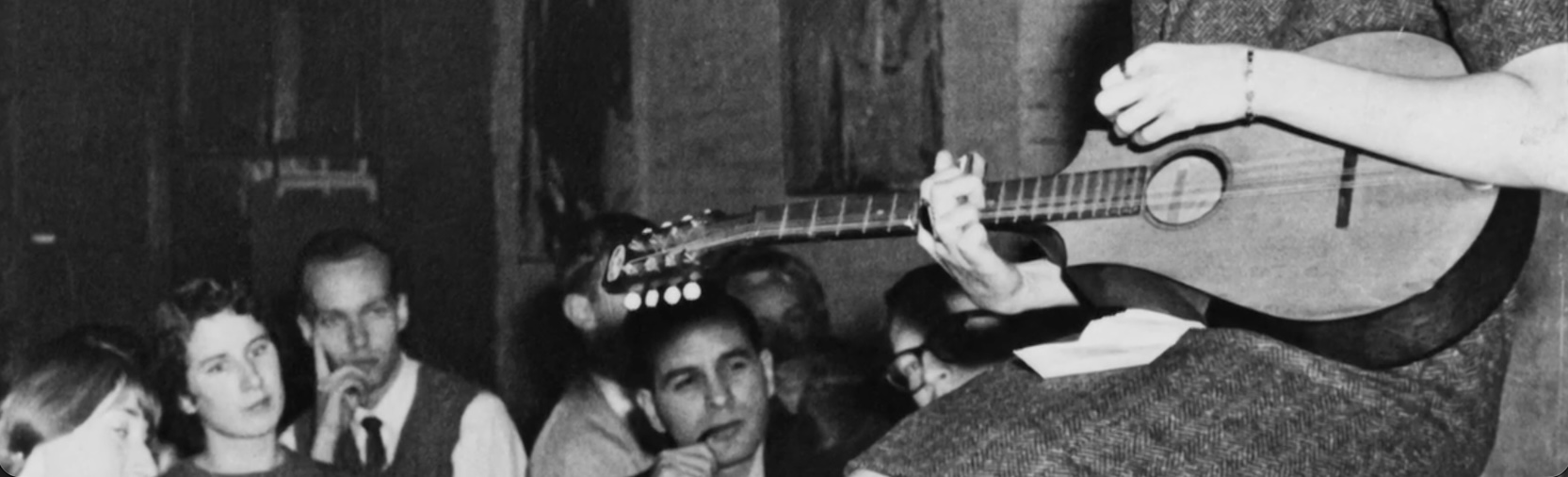
A transfixed Margaret Atwood at Toronto's foremost coffee, The Bohemian Embassy, in the early 1960s. [o]
When I was a student at Victoria College I had a small part in a student musical comedy called Don Quixote. I played a serving wench in a sort of dirndl and an apron. My role was to sing in the chorus while swinging an empty beer stein back and forth in a wenchy sort of way. It was quite an ambitious, professional production, and the organizers had come up with a bright idea to advertise it. They rented a live donkey — Don-Key-Ote, get it? — and the actor who played Don Quixote put on his leather armour and visor and was leading this poor creature around the campus with a poster for the show.
You need to build a world your reader wants to enter. That’s your truth-trap.
That day I was down in the basement of the library studying Chaucer in a carrel beside a glass wall at street level. It’s a good spot for procrastinating, because you can gaze out at the traffic orbiting the park across the road. But when I looked up, there was the actor and the donkey two feet away from me on the other side of the glass. The actor was trying to get the donkey to keep moving, but the animal was transfixed by something — by me, evidently. It was staring at me and braying loudly. It also had a pretty impressive erection. Well, I thought, they promised me new experiences at college, and I guess this is one of them. I did feel sorry for the donkey, though, because obviously it was about to be fired. So fired. This was fifty years before cancel culture but the protocol was still clear.
It was then I realized that the donkey was not looking at me, he was responding to his own reflection in the glass. He was gazing at another donkey who was apparently looking back at him. He had no interest in this sleepy student reading Chaucer (though Chaucer would have relished the scene).
I did take a useful lesson from this: not everything that happens around you is necessarily about you. Good to remember when you’re on social media. And we would all prefer to see what we want to see, and hear what we want to hear, rather than what is really there. Both the donkey and I were early victims of fake news.
I don’t need to remind you that truth is in dangerously short supply these days. There is a president in office in America who has made the world his mirror. According to his mortal enemy the New York Times, in his first year in office in 2017 he told over 2,000 certifiable lies. That’s slightly more than 5 lies a day. “Syllable by syllable,” NYT columnist Frank Bruni wrote, “Trump traffics in fantasy.” We are in an Alice in Wonderland time right now, where they’re painting the roses red and using flamingos for golf clubs.
How is this blurring of fact and fiction, this daily barrage of mendacity, going to affect what we call literature?
The American poet Adrienne Rich had something to say about this, in a collection called On Lies, Secrets and Silence. She wrote: “To lie habitually, as a way of life, is to lose contact with the unconscious. It is like taking sleeping pills, which confer sleep but blot out dreaming. The unconscious wants truth. And it ceases to speak to those who want something else more than the truth.” Which is to say that a writer who loses touch with her unconscious loses her creative compass, her personal grip on the truth. Rich then offers a definition: “Truth is not one thing, or even a system. It is an increasing complexity. The pattern of the carpet is a surface. When we look closely, or when we become weavers, we learn of the tiny multiple threads unseen in the overall pattern, the knots on the underside of the carpet. This is why the effort to speak honestly is so important. Lies are usually attempts to make everything simpler — for the liar — than it really is or ought to be.”
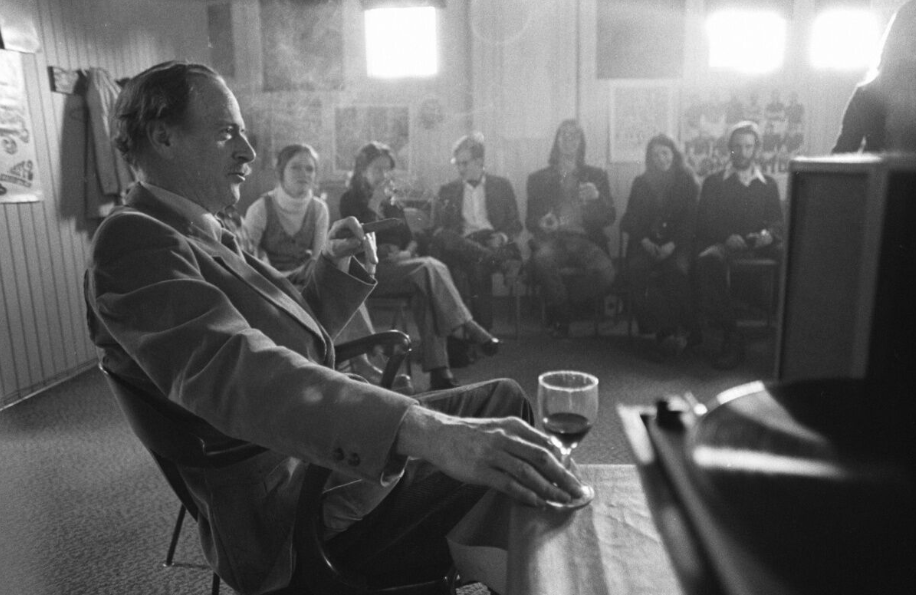
Being Marshall . . . Professor McLuhan leading a University of Toronto seminar in the late sixties. [Photo by Robert Lansdale.]
Writers, poet and novelists are the weavers who try to stay true to the complexity of the truth, while hiding the knots on the underside of the carpet. They help us see a more orderly pattern in the middle of chaotic times. And, more importantly, the good writers do not tell us what to think. They enlist our empathy and imagination instead. When you only write about your own beliefs you are placing yourself on the same spectrum as propaganda. Today beliefs, indignation and outrage often drown out reason, criticism and reflection. I know that makes me sound old, but I don’t know why mere sincerity has acquired a moral value all its own.
This past year has put us all in a narrative frame of mind, because the plot not only thickens but it keeps changing every day. Any good story needs high stakes, and right now the stakes are nothing less than the health of democracy, and the possibility of nuclear oblivion. Whereas literature, as Northrop Frye wrote, “speaks in a voice too quiet for panic to hear.” Even from our bleacher seats in Canada, this is the comic-book story swirling around us, rife with clichés and coarse, fragmented, careless language. We’re like kids at a party where the adults have all gotten hopelessly drunk and it’s not clear how we’re going to get back home.
We are living through a time in which fiction and nonfiction, news and rumour, fact and fervent opinion are so completely blurred that the only way out of this mess, I think, is through trusting — and using — our own voices. A young writer friend calls this strategy “extreme subjectivity”. When the larger narrative threatens to overwhelm, we need to ground ourselves in our own story, however local and modest. This is what literature in Canada did in the nineteen sixties when it shed colonial voices, and it’s what a refurbished and reconstituted, more inclusive Canadian literature — or any literature, for that matter — ought to do today. This is a time for brave individual voices, not mob-think.
These days I’m reading an example of that bravery, Seven Fallen Feathers, by Tanya Talaq. It’s about the suspicious deaths of seven Indigenous youths on the north shore of Lake Superior — a portrait of systemic racism that offers a useful background to the murder of Colten Bouchie and the acquittal of Gerald Stanley, the man who shot him, by an all-white jury. We need to educate ourselves, to read and think about why our government ever thought it was a good idea to pry 150,000 Indigenous children away from their families and their culture, because that darkest chapter is our story too.
Seven Feathers is a book of investigative journalism, based on years of digging for facts. But how do fiction writers build truth into their books? If you’re a young writer just starting out, you may wonder what's the point, sending a book out into this brittle, hostile climate. The only answer to such doubts is to sit down and make a sentence or one small scene in your story come alive. You need to build a world your reader wants to enter. That’s your truth-trap. It could simply be a yellow chair in a room with blue walls. Focus on the details, ignore the critic on your shoulder, and trust your voice.
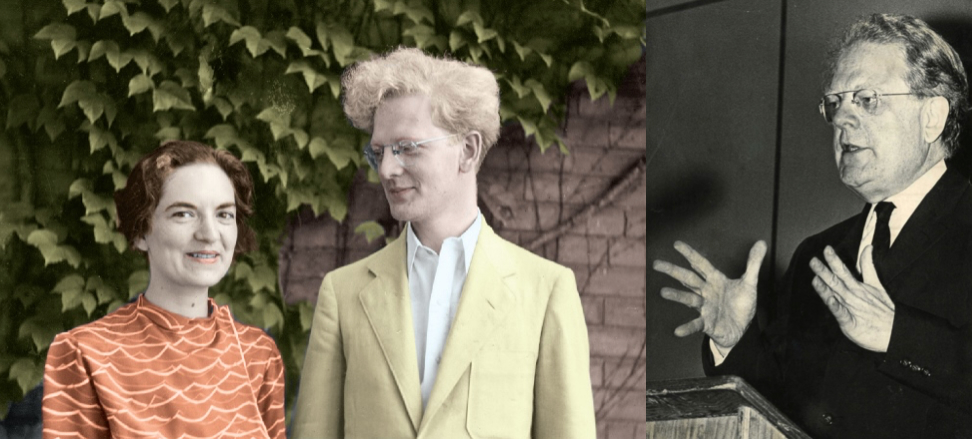
Northrop Frye with wife, Helen, early 1930s and later in action at the lectern: even the fingers appear to have deep thoughts.
When someone accused British novelist Hilary Mantel of having too much wallpaper in her historical novels, she said “I wish they had more wallpaper.” What the author of Wolf Hall — a book that is almost unbearably vivid — meant is that the details and the credibility of the world you create on the page allow the reader’s imagination to take root and grow. Fact and fiction aren’t two separate streams, they flow in and out of each other — and they support each other. Even the nightly news has begun to resemble a historical novel, full of wildly intimate details about who put whose hands or lips where. But the point of view in the news-as-novel changes depending on which channel you’re watching. Talk about unreliable narrators.
The New York Times once used the royal ‘we’ in its editorials. It was a baseline of truth, or so we believed. But ‘objectivity’ has become a quaint thing of the past. News anchors have become editorialists. Late night TV talk show hosts are warriors for freedom of expression. The voices of authority have multiplied, and sometimes drowned each other out. if you don’t have a point of view on an issue right now, someone else will quickly provide you with one.
But, as Mantel points out, we can't use a point of view to tidy up history. She writes: “This is a persistent difficulty for women writers, who want to write about women in the past, but can’t resist retrospectively empowering them. Which is false. If you are squeamish — if you are affronted by difference — then you should try some other trade. A good novelist will have her characters operate within the ethical framework of their day — even if it shocks her readers.”
This is something Margaret Atwood practices, to her evident peril: her treatment of the female characters in her fiction as both angels and demons, as full-spectrum humans. It’s a choice that has sometimes put her in the doghouse with younger feminists. But sometimes the doghouse is where writers must go in their lonely pursuit of what they believe to be true, rather than coming down on what appears to be the right side of history. Anyway, the doghouse is not news to Atwood. I was at Victoria College when she was a student there, and it’s worth remembering that at one time this icon of power and privilege, this “bad feminist”, was a 26-year-old woman trying to break into the tiny, scruffy and predominantly male world of Canadian poetry. Once upon a time, Margaret Atwood herself was marginal, and subversive, and people did not listen. (I confess that I even gave one of her early novels an ungenerous review in the Toronto Star.) But she persisted.
Here is Atwood’s recipe for writing the truth
The only way you can write the truth is to assume that what you set down will never be read. Not by any other person, and not even by yourself at some later date. Otherwise you begin excusing yourself. You must see the writing as emerging like a long scroll of ink from the index finger of your right hand; you must see your left hand erasing it.
And let me point out that if you’re active on social media, you’re already trucking in fiction; we are all micro-novelists online, nervously drafting our public alter egos. The portraits we see of our friends on Instagram and Facebook are not, we know well, the real truth. Your friend is not drinking mojitos by a lagoon 24 hours a day. Social media presents our lives as fiction — or let’s say, as commercial fiction. But it also keeps us awash in words, and text, and language, which is in no way a bad thing.
It used to be the case that typing was a special skill, like welding. Only secretaries and novelists knew how to type. Northrop Frye even began his illustrious career by winning a typing contest in Fredericton, New Brunswick. Now the qwerty keyboard is just part of our daily life. We all type, we all text, we swim in various muddy currents of language. So the literature of storytelling and argument is not disappearing. What it is doing is shape-shifting — in radical ways that Marshall McLuhan would relish — as our devices continue to change and rewire us. All-emoji novels are already available. Writing that endures gives us a reading experience that makes us feel (I have to resort to a cliché here) intimately seen and heard. “That character reminds me of my ex”, we think, or, “my mother would say that.” Literature gives us a sense of shared humanity, instead of disseminating distrust and hatred, which springs from propaganda. And the world is noisy with propaganda of all kinds right now.
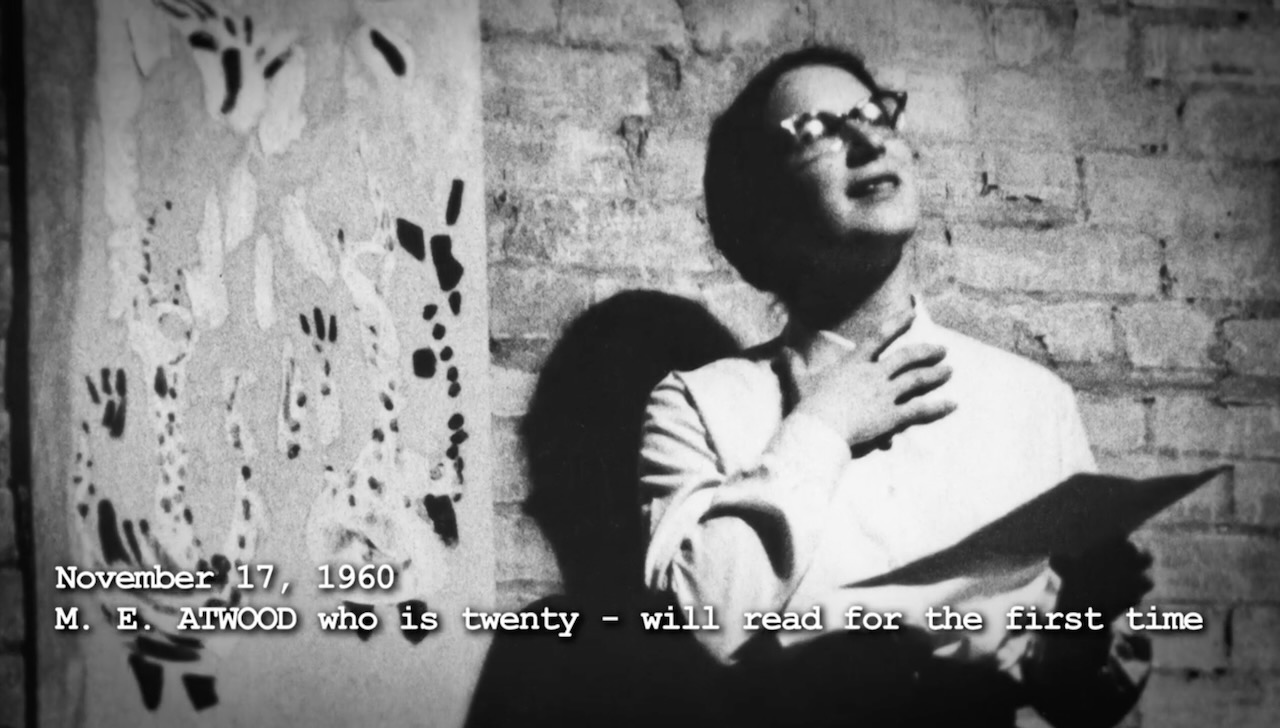
"Destiny is a feeling you have that you know something about yourself that nobody else does." — Bob Dylan. (Photo from the documentary Margaret Atwood: A Word After a Word After a Word is Power.) [o]
So we need to deepen our empathy, and to think more critically in order to ride the changes that are gripping us today. And how do we work those muscles, both of engagement and detachment? We can read, and we can write. It doesn’t have to be Beowulf, either. Lee Child’s Jack Reacher novels will do nicely. As Northrop Frye long ago argued in The Educated Imagination, all stories drink from the same well, and when we read something by Stephen King we are also stepping into the larger story that is world literature, with its roots in myth, magic and religion.
My professors at my college included Northrop Frye and the poet Dennis Lee. Marshal McLuhan was floating around the campus then too. No big deal: one of the most distinguished literary critics in the world, the country’s best contemporary poet, and the first guy to tell us that the future was going to be all about our phones.
I remember my first class with Northrop Frye, who taught an undergrad course called Religious Knowledge, or ‘RK’ as we called it. Professor Frye seemed to enter the classroom forehead first, like an ocean liner. He wore rimless glasses and his hair had a marvellous little wave on the top. He was a striking presence at the lectern, a kind of human statue broadcasting Thought. Frye never patronized this room full of freshmen who had no idea that their professor was on a list of the most-quoted writers in history that included Aristotle and Shakespeare. And if one of us asked Professor Frye a question, the answer did not come quickly. He would stand in silence, thinking, for what felt like a long time. It might have been the first time I witnessed deep thinking in action.
Eventually he would offer the student a clear, considered and often subtly mischievous answer. If you’ve read The Great Code, or Fearful Symmetry, or The Bush Garden — or any of Northrop Frye’s books — you will find them models of lucidity, and a rebuke to anyone who denigrates “academic writing”. Frye wrote clearly because he thought clearly. Intelligence should elucidate, not complicate, and that’s what Frye’s writing style taught me.
Frye’s long silences in the classroom were an example of someone literally thinking on their feet. He treated the classroom as a place where everyone, including himself, could come to ideas in a fresh and individual sense. Of course I took this example for granted at the time. But I registered his respect for his students and wanted to be worthy of it.
Another lucky thing: my course in Modern Poetry was taught by Dennis Lee, soon to co-found the House of Anansi, one of the first publishing houses to bring Canadian writing to Canadian readers. As one writer has described him, Dennis had a slightly pastoral air. He smoked an omnipresent pipe and often wore a dashiki shirt. (That would not pass muster today, if indeed it did back then.) In his Modern Poetry course he was doing something unheard of in 1964 — he was teaching Canadian literature and Canadian poetry, a subject at the time I happened to have a serious crush on.
I grew up in a house that valued books and aspired to culture. My parents, the first in their prairie families to go to university, once bought a dictionary in instalments that ended up being the size of a cement block, held up by its own special stand. My father liked to draw my attention to the “How to Increase Your Word Power” page in his favourite magazine, Reader’s Digest. My attachment to books was both an expression of my family’s curiosity and openness to the world, and an escape from our WASPy small-town life. The beatnik life appealed; I was reading Albert Camus and Sartre at 13 while lying on the rug listening to my first LP, Jazz Ecstasy. At fourteen, I took a suitcase of poetry books with me to summer camp, which caused the camp director to take me aside to ask if “Everything was alright?” Everything was not alright, and that’s why books mattered so much to me.
Frye himself argued that “the story of loss and regaining of identity is, I think, the framework of all literature.”
In my teens I had discovered the poems of Leonard Cohen, Irving Layton, P.K. Page, and others in a very un-Canadian sounding anthology called Love Where the Nights Are Long. I hadn’t yet heard the term ‘CanLit’, as it would be called, but I had stumbled on a slim thread of it by chance. At 16, I read Cohen’s first novel, The Favourite Game, and wrote him a letter thanking him. He wrote back from the Chelsea Hotel. That letter got me through my adolescence.
What I also didn’t realize was that being a writer in the early sixties in Canada was less a career choice than an eccentric hobby, like collecting string or making hand puppets. I just knew there was something in those poems that hooked me. They contained snow and trees and Montreal balconies and details I recognized from my own world, a tone of voice both lyric and ironic that sounded vaguely like my own. It’s true that there weren’t enough women in my literary diet and that my reading world back then was very male and very white. But I was determined to work with what I had.
I remember going to one of Margaret Atwood’s readings when she was a grad student. She had not yet developed her way with a colourful scarf, and looked like any other drab grad student. What I found remarkable about her was that she was not out to please, and never has been. Her poetry was like an arrow: elegant, pointed, sharp — and a little lethal. She was unknown then, but I was deeply impressed, not just by the work but by the fact that here was a poet in her early twenties who already had a voice of her own. So, ho hum, I thought, if a grad student can write this well, how hard can it be? Atwood made the role of the writer seem possible for me, even though I soon found out just how hard it was to be good at it. I worked on the college literary magazine, Acta Victoriana, and published several very bad poems in it — under the clever pseudonym, I thought, of Sue Dunham.
After I graduated, I worked for a brief time as Dennis Lee’s editorial assistant at the House of Anansi, which he co-founded. I lived there for several years, in the attic of the Anansi narrow Edwardian house on Spadina Avenue. Now that CanLit is being viewed as this monolithic fortress of privilege, it’s worth noting its shaggy, communal, fractious beginnings. CanLit is really a story of two Victorian houses and a brick coach house in Toronto close to the university, and this was where the writers who now define the CanLit pantheon first came together to read, edit, publish, marry, betray and divorce each other. One author, the Trinidadian novelist Harold Sonny Ladoo, was mysteriously murdered during a trip back home. Two other Anansi authors committed suicide. It was not a placid time.
Certainly Marshall McLuhan had a big effect on me, he who was already making waves as prognosticator for communication technology, as it was known back then. McLuhan was tall, a crane-like, diffident figure whom I remember folded into whatever couches and chairs he occupied while holding seminars or being interviewed for Playboy. He became an international star, back when Canada had none. I wasn’t a student of his, but I remember coming home one night to 671 Spadina where a living room full of grad students were huddled around him as he followed a line of thought down another rabbit hole. I had to detour around his long legs to make my way to the kitchen.
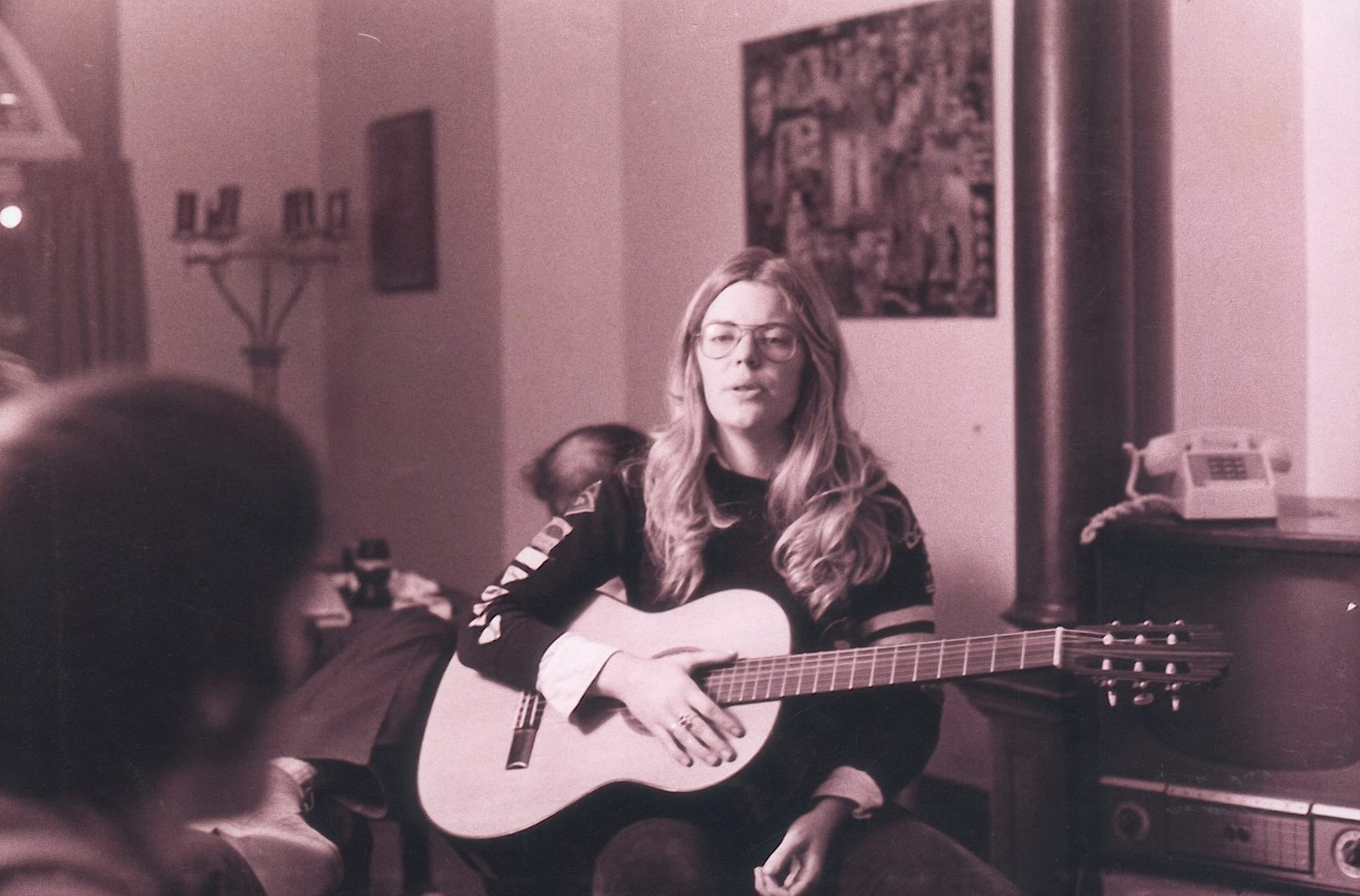
At ease, holding court . . . The author in her student and editorial assistant days at 671 Spadina Avenue. [Courtesy of the author.]
McLuhan’s thinking was brilliant, strange and wonderful, if not an easy read on the page. So much of what he had to say in the nineteen sixties has not only come to pass but now defines our cultural landscape. He was an academic crossed with an ad man, a media shaman who foresaw the power of pop culture paired with the new communication technology. He had a passionate interest in museums, for instance, and was an early proponent of interactivity in exhibits. When you push a button to make a diorama come alive, that’s also McLuhan’s influence.
The obvious downside of this list is the lack of women’s voices, or professors and authors from non-white backgrounds. I was both lucky, and unlucky, privileged and deprived. We shook off the British and American influences but we had yet to acknowledge, publish, support and award the multiplicity of voices that actually make up our country and represent our history. In the first CanLit explosion, we were largely ignorant of our other traditions — of Indigenous storytelling or of African-Canadian writing, of voices from other cultures. So, the pushback to colonialism continues. First there was exclusion — goodbye to the poets of the first part of the 20th century who wanted to write like Wordsworth. Now there is inclusion, at least the rough beginnings of inclusion. We are belatedly recognizing that our storytellers are as many-spirited and diverse as our weather. And we are lucky, I think, that our population resembles the whole world. That we all have to shovel the snow, all share the fact of the land. CanLit these days is post-national — and I look forward to the day when it is post-gender and post-generational too.
In his highly readable and insightful book about the CanLit story, Arrival, Nick Mount writes that Canadian literature has largely been a search for a lost identity, a series of darkish elegies for a nation that has never quite jelled. George Grant expressed the same idea in Lament for a Nation, and Frye himself argued that “the story of loss and regaining of identity is, I think, the framework of all literature.” But this could be the heart of our identity, this kingdom of absence and constant uneasy re-evaluation of who we have been and who we are becoming. It’s a fluidity that to me seems modern, global, and appropriate to our times. Maybe our slogan should be Make Canada Vague Again.
But my years at university and the following decade of living and working in close quarters with the emergence of CanLit taught me this: poets had clout, writers could write about their times and world and find an audience, and that writers could publish each other. And most of all, I believed that books mattered. They were at the centre of the cultural landscape. And magazines were full of long, well-written and substantial articles. I began to freelance for magazines when the rate was exactly what the rate is today: $1 a word. Thanks to Atwood’s poetry readings and Dennis Lee’s swashbuckling attitude to publishing, I saw no impediment to becoming a writer. I marched down to the Toronto Star and asked the book editor there if they could use a new reviewer, and for almost ten years I lived on my freelance income from reviewing books. Anyone who attempted that today would soon be dumpster-diving.
So my own writing life began in journalism and has now leaned over into the realm of fiction, although I don’t believe there is a hierarchy between nonfiction to fiction. It’s just a matter of getting from one sentence to another. One of Frye’s teachers at Victoria College, Pelham Edgar, told him that if the rhythm of a sentence was right, its sense could look after itself. The other thing to remember? You don’t want to try to be the next Michael Ondaatje or Elena Ferrante. You want to try to be the writer you already are, unencumbered by other voices.
These days the bottom line more and more determines what publishers will gamble on, and then the bottom line keeps changing. Like everything else, writing is now a hustle.. But I am optimistic. I trust readers, and readers still want true voices, so the job of writing is still the same job. And the writers are recasting CanLit in a way that reflects our present and future, not just the past.
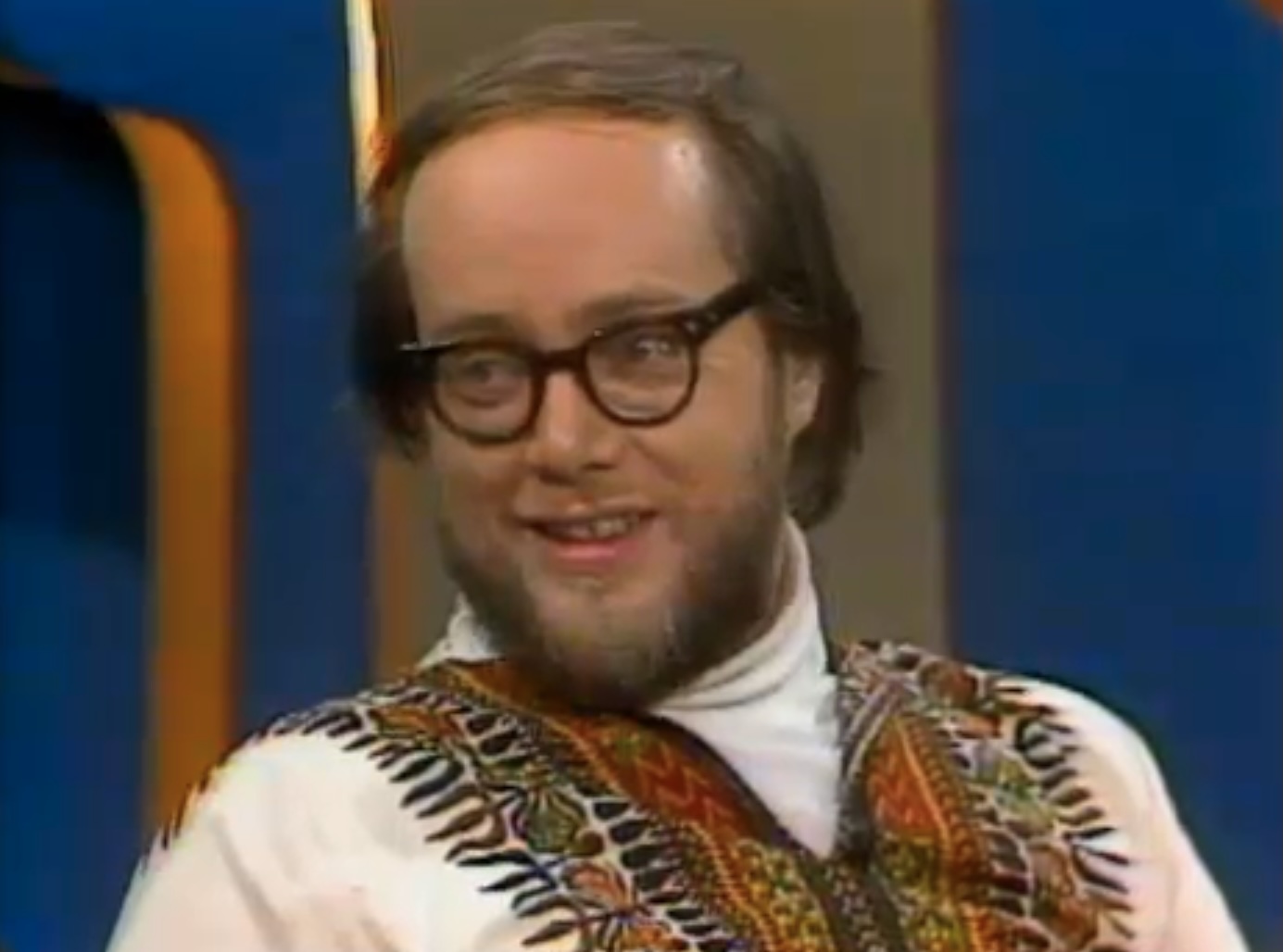
On to greater things . . . The author's English professor and boss, the puckish Dennis Lee, modelling a dashiki shirt while explaining his new children's bestseller, I Eat Kids Yum Yum, 1977. [o]
I think social media is both good and bad, connecting and isolating us at the same time, but it has also advanced what I’ve been calling a narrative state of mind. That is, culture is unfolding more as a collective story that is constantly being revised and redacted, like one long Wikipedia entry. This is messy and inelegant, as it invites extremism, which we are witnessing. On social media, voices are raised and noisy conviction often upstages critical reflection. But sometimes one voice can, overnight, reach a vast audience and this is good news for a writer. The danger is that young writers will push a political agenda before they have a chance to develop their craft and — how shall I put this? — their wisdom.
The next generation shouldn’t always be burdened with changing the world or correcting their elders or feeding our fears and doubts. They simply need to tell their stories well. And, we need to listen.
The writing and reading of fiction helps save us because it asks us to imagine other lives. If we allow it to. Social change, genuine social change, is based on our ability to imagine people who are different from ourselves. This is the heart of empathy, and literature keeps the empathy muscle strong and supple. Literature shows us the world with a coherence and shape that allows us to see it in a sharp new light — in all its badness and its goodness.
I’d like to conclude with a quote from The Educated Imagination
There is something in all of us that wants to drift toward a mob, where we can all say the same thing without having to think about it, because everyone is all alike except people that we hate or persecute. Every time we use words, we’re either fighting against this tendency or giving in to it. When we fight against it, we’re taking the side of genuine and permanent human civilization.
Lofty words, but words do matter. Books matter. I hope you will keep reading and writing. =ç

MARNI JACKSON is a Toronto writer, journalist and playwright specializing in humour and social commentary. Her nonfiction books include The Mother Zone (1992), Pain: The Science and Culture of Why We Hurt (2002), Home Free: The Myth of the Empty Nest (2010, and a book of fiction, Don’t I Know You? (2016). She lives in Toronto. Visit Marni's site at marnijackson.com.
This essay originated as a speech at Victoria College in 2016 and was later published in the literary journal, Brick. It appears here in a revised form.
Add new comment