

"A hospital stay asks a great deal of you. It tests your patience, your resilience, and sometimes your sense of self." Photograph by Heather Patterson (inset). [o]
A hospital stay can feel overwhelming, unfamiliar, and frightening. But with the right mindset and a few practical habits, you can be an active, informed participant in your own care. That’s what being a ‘successful patient’ means.
Your time in the hospital will vary from day to day. By attending to a few simple things, you can have more control over the experience than you might expect.
1. TRUST YOUR MEDICAL TEAM
Most of the doctors and nurses around you have years of training and experience. Recognizing their competence is one of the most important things you can bring to your hospital stay.
You may have friends and family members who feel they know better what to do than the medical staff. It is usually best to follow the guidance of the professionals caring for you. If there is genuine disagreement, raise it respectfully.
Pay attention to what nurses know. They are with you more than anyone else and are often the first to notice changes in your condition.
That said, trust does not mean silence. You have a legal right to ask questions and receive honest answers. Use that right.
Try to find the interest in your surroundings rather than fighting against them. Trying to control the hospital around you will only exhaust you and frustrate the staff.
2. ASK QUESTIONS — AND KEEP ASKING
One of the most important things I learned was this: If you ask a question and receive an unsatisfying answer, ask again. Politely, but persistently. And perhaps discuss your concerns with someone else for an extra opinion about your care.
You are entitled by law to have your questions answered honestly. The people caring for you want to help — sometimes you simply need to make your concerns clear.
If you don’t understand something about your treatment or medication, ask for it to be explained in plain language.
If you receive a vague or dismissive answer, try rephrasing the question or asking a different member of staff.
Write down questions when they occur to you so you don’t forget them.
Being persistent is not the same as being rude. Advocating for yourself is a healthy and necessary part of being a patient.
3. FIND THE RHYTHM AROUND YOU
It’s hard to be in a situation where you feel helpless. But trying to control the hospital around you will only exhaust you and frustrate the staff. They have been doing their jobs for years.
Instead, slow down. Focus on what you can influence.
Concentrate on the small things that bring comfort — food, a good conversation, a moment of rest.
Try to find something to enjoy, however unexpected. (Basmati rice and perfectly prepared chicken in a hospital meal — who would have thought?)
If a staff member treats you poorly, resist the urge to seek revenge or file an immediate complaint out of frustration. It rarely helps. More importantly, it takes energy away needed for the healing process.
Hard things have hard cures. Easy things have easy cures. Put your energy into the things you can actually change.
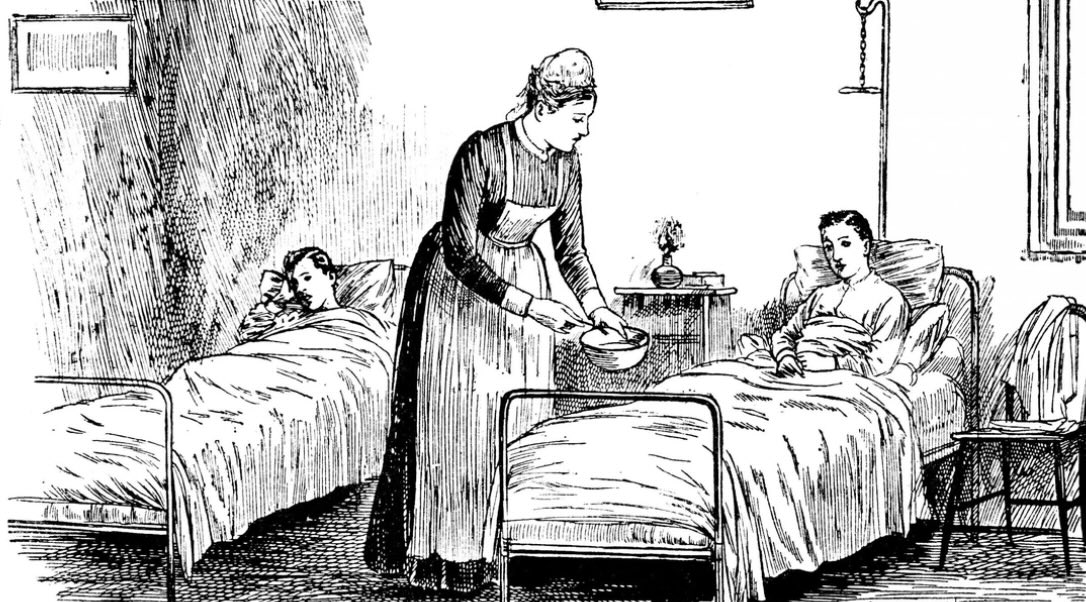
Introduce yourself to every nurse who cares for you. It changes the dynamic immediately. [o]
4. BUILD CONNECTIONS WITH YOUR NURSES
The nurses are often angelic. They also are very busy, under-resourced, and often managing far more patients than is comfortable. And yet they mostly show up with patience and a caring attitude.
One of the simplest and most powerful things you can do is introduce yourself by first name. It changes the dynamic immediately. You become a person, not just a bed number. Introduce yourself to every nurse who cares for you. Use their first name too.
Be patient when you ring for help from a nurse or other hospital worker. They hear you — and they will get to you — they are just managing several patients at once.
When you ring more than once, nurses read it as urgent. Use the call bell wisely and save repeated presses only when it’s urgent.
If you ring and nothing happens, ring again. But before you do, wait a reasonable amount of time.
Remember that at night one nurse may be covering up to six patients. If a colleague is on break, that nurse may have twelve. Be considerate.
If you have a family member or a Personal Support Worker (PSW) who can be with you during the day, this helps enormously — both for you and for the nursing staff.
5. YOU KNOW YOURSELF BEST — SPEAK UP
Medical staff are trained in clinical care. But you are the expert on your own psychological and emotional experience. If something is bothering you and you think there is a solution, say so.
On difficult days — when pain is poorly controlled or you feel anxious — don’t suffer in silence. Share what you think might help. The nursing staff are receptive when you approach them constructively.
If you are in pain and feel it is not being adequately managed, describe what would help and ask whether it is possible.
If the environment is causing distress — noise, lighting, temperature — mention it.
If you notice something that needs fixing (a piece of equipment, a safety issue), report it to a supervisor. Staff told me that patient reports carry more weight than staff reports do.
Don’t be afraid to just tell it like it is: “It’s been really nice to see you. Thank you for coming. Now I have to rest.”
6. NAVIGATING THE WARD ENVIRONMENT
A shared ward is a busy, noisy and occasionally chaotic place. You will hear the lives of other patients unfolding around you — their conversations, their struggles, their stories. The whole environment can be surprisingly interesting.
There will also be alarms. Beepers going off constantly, unpredictably, and at all hours. There is little you can do about this. They will eventually be silenced.
Report a beeping alarm through your call button, but only once. Do not report the same alarm repeatedly — the staff are aware and doing their best.
Bring earplugs or headphones if noise is a concern for your sleep. Hospitals can often supply mild sleeping pills, if you ask.
Try to find the interest in your surroundings rather than fighting against them.
The ward is often short-staffed. Patience and understanding go a long way — for you and for the people caring for you.
7. SOME EXTRA TIPS
A. TIME
There are no clocks in many hospital rooms, so bring one with you — a small clock or wristwatch or a phone kept within sight.
Time becomes disorienting very quickly, especially when you are managing pain and waiting for the next medication dose. Knowing whether you have 20 minutes or 90 minutes to wait makes an enormous difference. Ask when your next dose of pain medication is due, and write it down.
B. CLOTHING
Bring a loose, long-sleeved cotton shirt and comfortable, loose-fitting pants. (I brought my parka and used it a lot. See photo below.) My personal favourite pants are ones that have a strong elastic waistband (not with a separate belt) that I can hang occasionally required items from, and a drawstring that can be tied in a bow and easily tightened.
C. MEDICATIONS
Keep track of them. Medications are added and sometimes changed throughout a hospital stay.
Try to keep a running list of what you are taking and why (again, ask questions). Ask what each new drug is for and what side effects to watch for.
You won’t always be able to ask questions, but when you can it helps to ask clearly expressed questions and stay informed.
D. MAKE NOTES ABOUT WHAT’S GOING ON
Write down any new medications or new instructions in a small notebook that’s easy to write in while in bed, or use your phone.
Questions you want to ask the nurse or doctor.
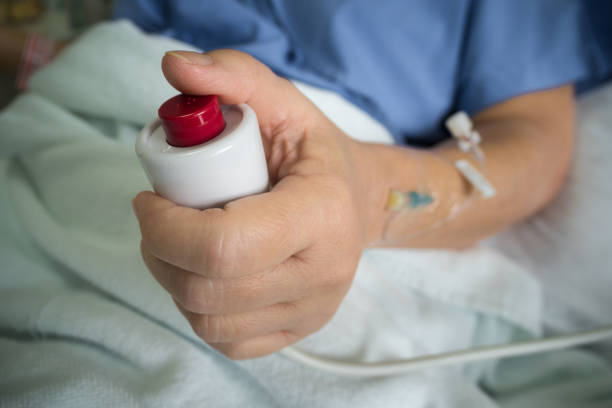
The ever valuable call bell. "If you ring it and nothing happens, ring again. But before you do, wait a reasonable amount of time."
E. KEEP YOUR BELL CLOSE
Your call bell — the device that summons nursing help — is your lifeline. Use it without hesitation when you genuinely need help.
If it is tied inconveniently to your bed, get it untied.
The call bell and its cord tend to migrate. Maybe you're lying on top of it. Try not to get it folded in your sheets where you can’t find it.
Since it must be accessible at all times, even when you're sleeping, try to keep it in your hand or within sight and easy to reach. When you wake up, you don’t want to have to search for it, it needs to be . . . right there!
8. GUIDANCE FOR VISITORS & YOU WHO RECEIVES THEM
Well-meaning visitors can sometimes be more tiring than helpful.
Family and friends want to show their concern as well as get some essential information about your condition. Tell them how you are in a few words, then lay back and relax so you can enjoy the visit.
Have a medical term that you can easily dispense — they tell me I have endo-encyclic-parabolic-throbitis, or some such thing — that describes what’s going on with you. Rather than asking you to explain everything while you are trying to expend less rather than more energy, encourage them to look up information on their own about what you’ve told them.
Allow visitors to know that their most helpful role may simply be to sit quietly and keep you company.
Don’t be afraid to just tell it like it is: “It’s been really nice to see you. Thank you for coming. Now I have to rest.”
Feel free to ask for shorter visits on difficult days.
9. THE HOSPITAL TEAM
A hospital stay asks a great deal of you. It tests your patience, your resilience, and sometimes your sense of self.
But it also puts you in the company of people — nurses, doctors, fellow patients — who are doing their best under arduous conditions.
The more you can bring curiosity, patience, and a willingness to speak up, the better your experience is likely to be. You are not just a passive recipient of care. You are a participant in it. ō
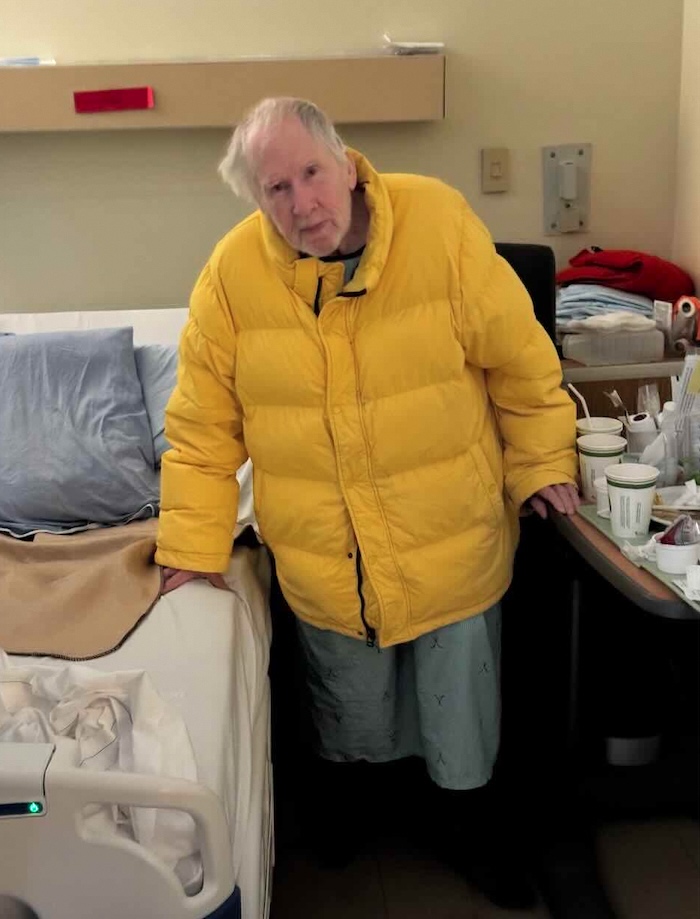
Portrait of the author in his down parka. He sometimes wore it in bed, despite the moderate temperature of the ward, and was most comfortable.

MAX ALLEN served as a radio producer at the Canadian Broadcasting Corporation on the programs As It Happens and Ideas for five decades. In 1975, he co-founded the Textile Museum of Canada. He was the editor of the two-volume autobiography of Eberhard Zeidler, Buildings Cities Life. He is currently working on a book entitled What the Guna Know, which is about the traditional craft created by the Indigenous Guna people of Panama, Colombia, and the rising waters of the Caribbean. He lives in Toronto.
Add new comment