
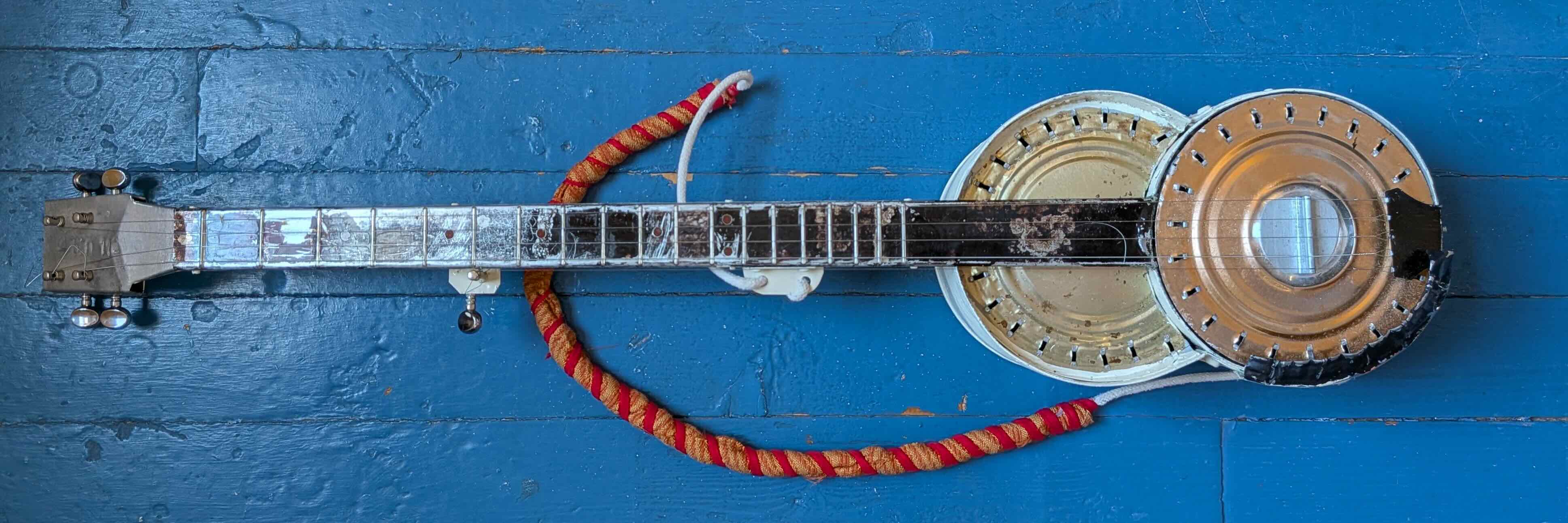
 The author's axe. "Every time I passed it in its resting place by my favourite chair, I had to pick it up"
Summer in Ontario, the season of steamy sunny days, long warm nights, BBQs on back stoops, and the ubiquitous summer craft fair. For myself and my wife J., and a slew of other Ottawans, it’s a place to marvel at the talent and ingenuity of people committed to art and craft.
One booth at the fair really caught our attention. It displayed musical instruments unlike any we’d seen before — a tin can ukulele, a tin can violin, and, of special interest to a banjo player like me, a beautiful tin can yellow banjo. I approached the maker, Ross Stuart, a quiet and self-assured gentleman with a grey-white stubble.
“Do these work?” I asked.
“Try one.”
For him these are not art pieces. What they look like is merely a consequence of his design principles.
Having played banjo since I was a teenager, I picked up a miniature-sized parlour model about the size of a small guitar. I struck a C chord. The sound from this strange-looking instrument had a pure, sharp resonating tone, superior to any banjo I’d owned in the past.
I played other chords and did a bit of picking. What an amazing instrument! The luthier, clearly an artist, had managed to produce singular products which had both tonal quality and a unique and pleasing appearance. It was also about a third the size and weight of my current and heavy five-string banjo which weighs about 9 pounds. Now in my eighties, light is good.
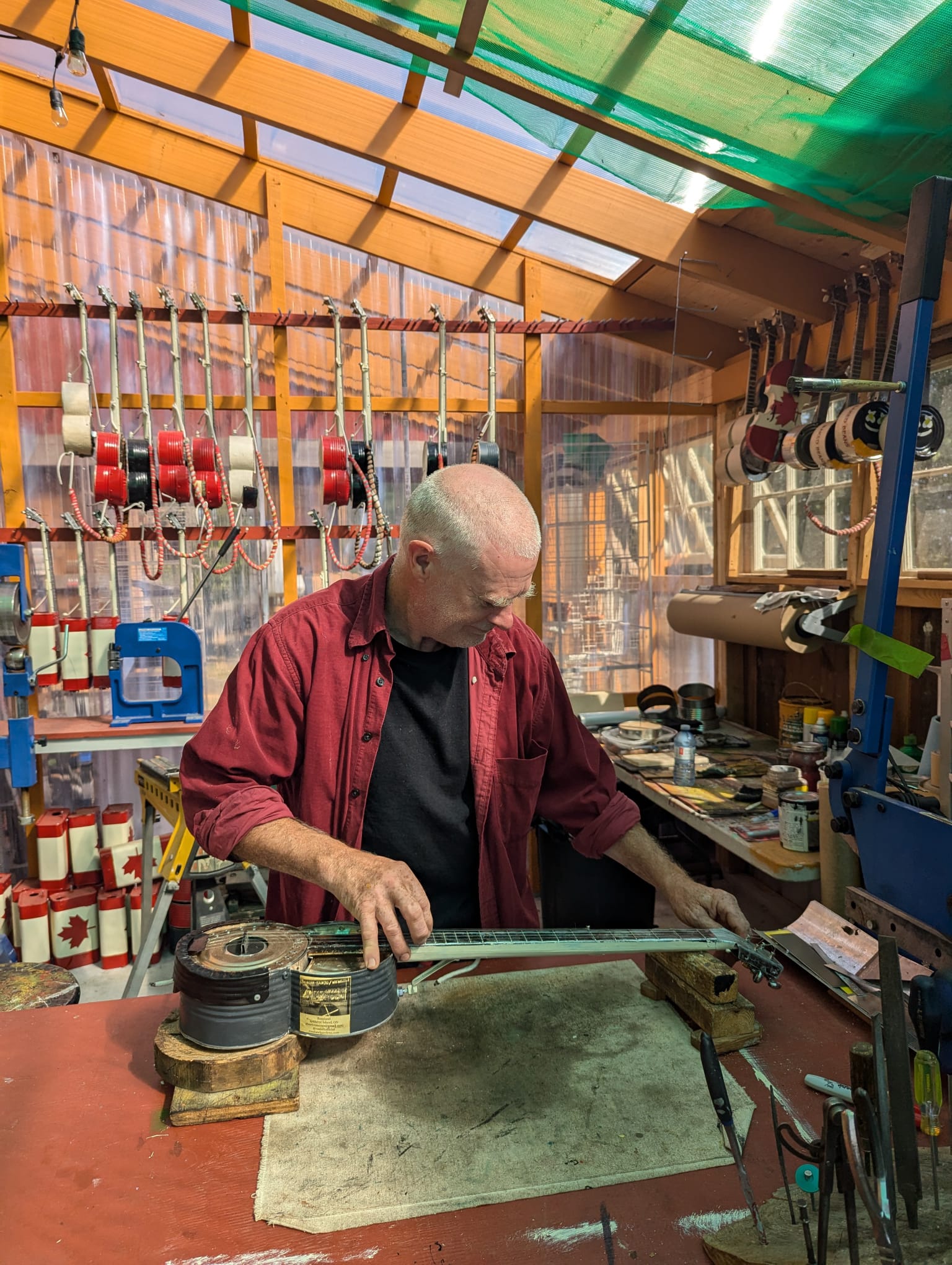
The luthier at work on one of his banjos. Tin cans on the floor wait to be transformed for new good purposes.
There was no question in my mind about this banjo, I had to have it. And not just because I was paying a quarter the price of a similar sounding instrument in a music store. When we got home, I couldn’t stop playing it. Every time I passed it in its resting place by my favourite chair, I had to pick it up. Soon it became an integral part of my daily routine, and even more important, this was an instrument that widened the bounds of my creativity. At $350 it's been worth every penny.
I was moved to email Ross and tell him how pleased I was — by the banjo’s sound, weight, and something especially important to those who play string instruments, how well it kept its tuning. He wrote back with an enthusiastic and grateful response and invited us to visit his workshop.
In early October, we found ourselves on the Millhaven Ferry, near Kingston, Ontario, headed towards Amherst Island, home to 450 residents, a number that swells in the summer. The inhabitants are a mix of long time residents, some descending from the first European settlers and later United Empire Loyalists in the late 18th century. Dry stone fences that echo of a past agricultural-based economy sweep across the fields and border the gravel roads, while towering wind turbines dot the horizon.
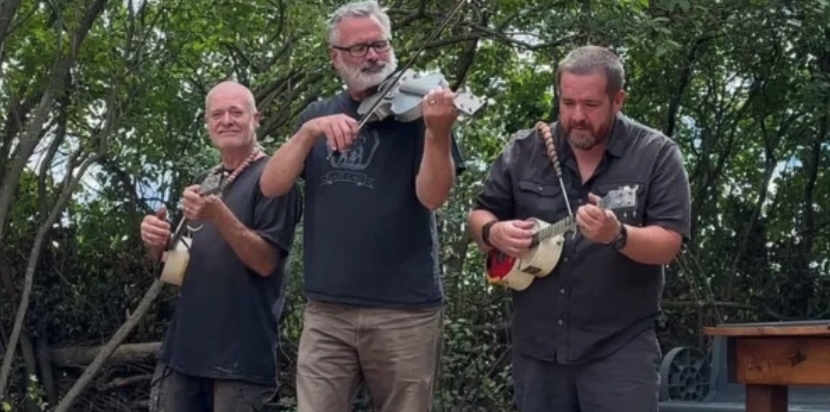
Ross Stuart (left) and fellow musicians perform using his found-material instruments. [o]
Down one of those gravel roads lies the home of Ross Stuart and his partner Darlene. The house is a marvel of ingenuity and vision, painstakingly rebuilt and re-imagined from the surviving timbers of the original homestead of a Lieutenant John Howard, a British officer and United Empire Loyalist who fled the US in the 1790s to settle in Upper Canada. The surrounding land hosts an extensive vegetable garden, from which Ross and Darlene plan to produce enough for their yearly needs. Just down from the house is a vast tract of land in the process of being rewilded and now attracting a host of insects and birds. Closer to the house, in the former chicken coop, is a gallery curated by Darlene that houses a selection of fine crafts by artists from across Canada.
Built off the side of the main house, Ross’s workshop is a sumptuous and colourful array of tin can instruments in various stages of completion. In hearing him talk about the workshop, it becomes clear that functionality, durability, simplicity, and affordability — his guiding principles — are at the core of his journey to build what he sees as the perfect instrument. For him these are not art pieces, and aesthetics do not guide his process; what they look like is merely a consequence of his design principles.
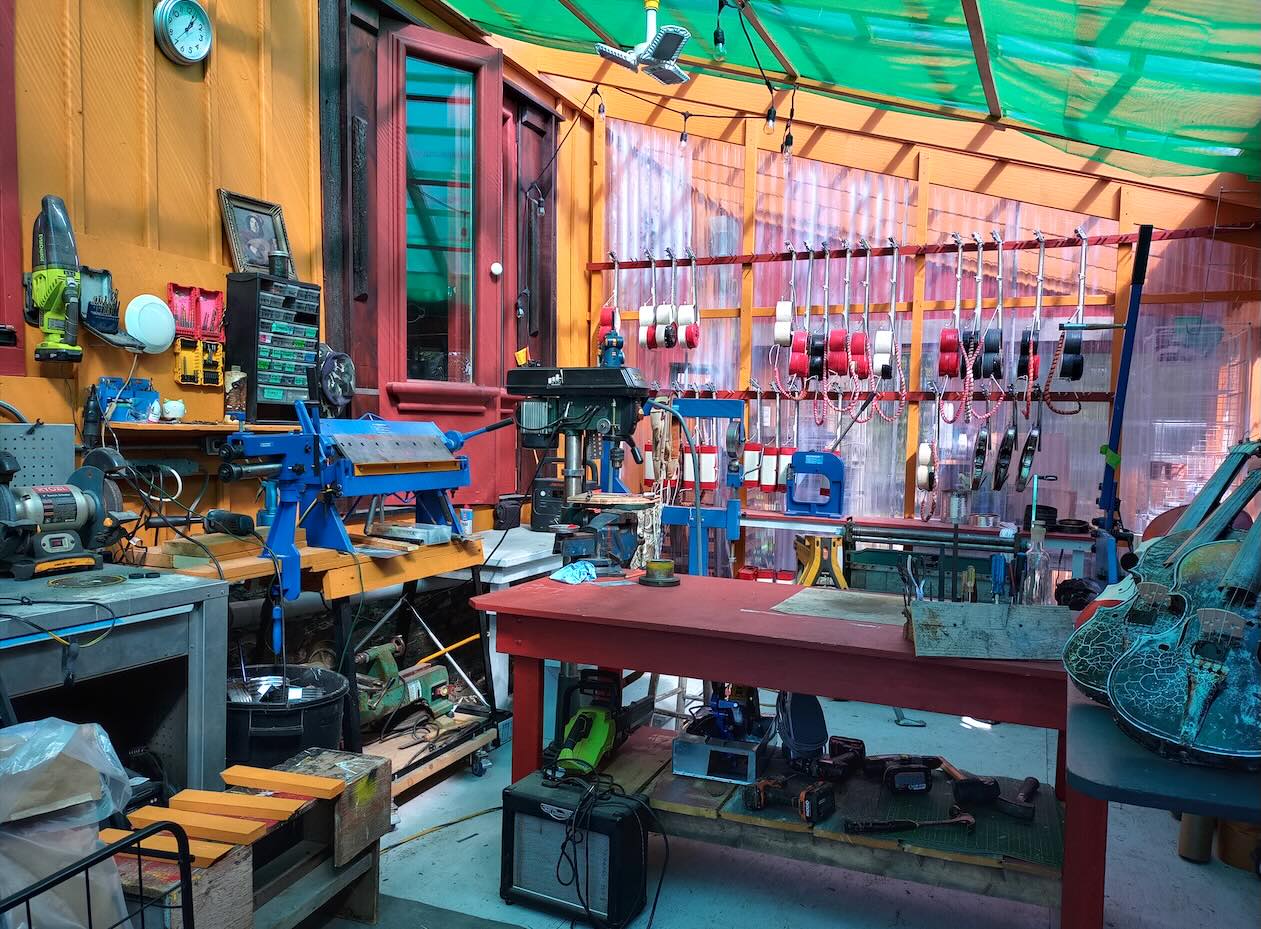
The workshop of Rossland Tin Can Instruments.
In his twenty-year quest to build the optimal instrument, Ross has constructed bodies of turned-wood, or used tossed-away tin cans from Toronto’s Kensington Market he’s searched for on his bicycle. Once he discovered the perfect tin can for optimal resonance, he began building his own resonators. After a lot of trial and error, he simplified the manufacturing process by eliminating welded seams and instead folding and fastening the metal with nuts and bolts.
When I play Ross’ banjo and ask myself why such a radical and some might say ‘primitive-looking’ instrument sounds so good, the answer is easy. Not unlike Leo Fender who made history by building the first Fender guitars out of two pieces of lumber and a bit of hardware, Ross Stuart is a tireless innovator using found objects. Twenty years and 4000 instruments later, he continues to pursue a noble ideal shared by those passionate about their craft — how to make a thing people love owning. ≈ç
OTHER ARTICLES by Stephen Richer:
• Ten Songs that Made a Difference
• The Protest Legacy of African American Spirituals, Part 1
• The Protest Legacy of African American Spirituals, Part 2
• Ten Canadian Songs That Made A Difference
• Western Songs and the Myth of the Cowboy

STEPHEN RICHER is a Professor Emeritus at Carleton University where he was head of the Sociology and Anthropology Department. He has been a folk and protest singer since his teens; these days he teaches courses occasionally on the history of protest music at Carleton’s Institute for Lifelong Learning Program. Stephen's lecture on the life and influence of Pete Seeger can be seen here. He lives in Ottawa.
Photos by Janine Smith, except for the tin can trio (photographer unknown).
Comments
What a charming and…
What a charming and uplifting story about two people who are passionate about a particular activity - the maker of tin can instruments for twenty years, and the banjo player, in his 80s, who is experiencing daily joy in playing this ingeniously made and light instrument from found materials!
Add new comment