
Algae are single plant-like organisms that make their own food through photosynthesis, like plants do. Unlike plants, algae have no roots, leaves, or flowers.
My story begins when I left Croatia to come to Canada to study fine arts in Toronto. It was just before the pandemic and I was isolated in my student apartment without access to studios or materials to do art. What I did have were a few boxes of delicious Wakame seaweed salad in the fridge.
While I was eating one of these salads, I realized something odd about it. When the algae was cooked it released gelatin, and the result of the heating is a gluey material that can be easily stretched and shaped. Not just that, this material is also beautiful — and reminded me of the glasswork I grew up around on the Croatian coast. When light passed through it contained both shadows and illumination — as if paper and glass had a baby. Yes, it had beauty, but even more important was this: though it was fragile when wet, when it was dried it became structurally resilient. Realizing these qualities of what I had in my fridge, I got to work right away.
The more I failed in sculpting the piece, the more I realized it had a will of its own.
What I soon learned was that the living algae culture took carbon dioxide from my breath, ate it up, helping the algae to grow — but also sending off oxygen which I then breathed in. This creates a mutual exchange where my breath sustains the plant and the plant sustains me. My breath (CO2) is the "call" and the plant's photosynthesis (O2 release) is the "response'.
Back to my story. To secure a steady supply I started an algae farm in my tiny bathroom. Of course at the time I was totally unaware that algae in the oceans capture roughly fifty percent of global carbon pollution and produce a similar amount of daily oxygen. Thanks to the algal oxygen supply, the more algae I cultivated, the more productive I became.
Since I didn't know how to work with the algal biomaterial properly, my first sculptural piece was a problem child. The more I failed in sculpting the piece, the more I realized it had a will of its own — constantly breaking, twisting, and bending without me really doing much to it. Once it shattered into pieces because of an unexpected gust of wind. I ended up doing a lot of repair work, which made the act of repair into my art practice — suddenly I was involved in healing, caring and expressing hope for my piece.
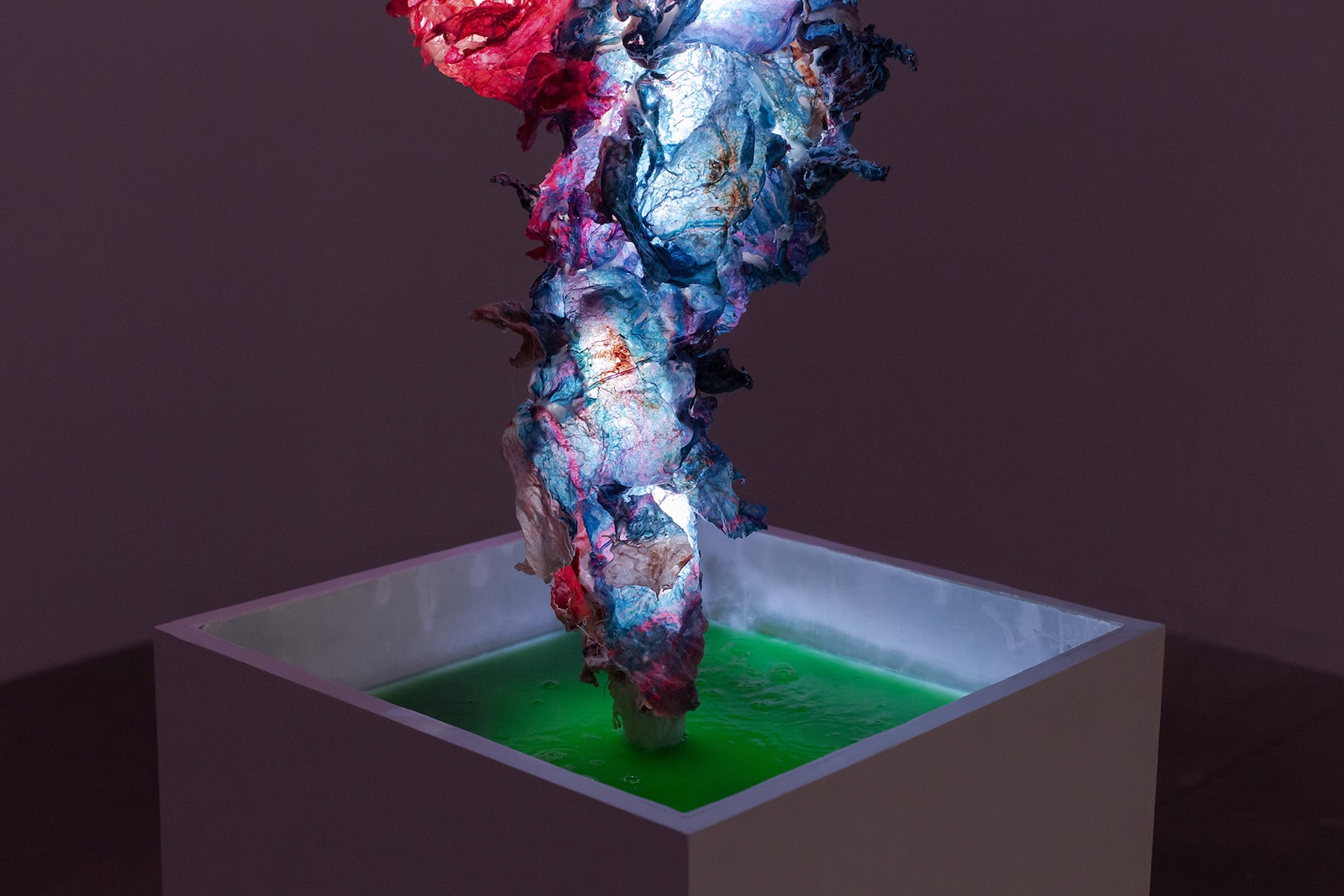
The carbon dioxide in the breath of each gallery visitor walking by the sculpture is absorbed by the living algae culture in the liquid, causing the sculpture to get bigger and bigger. This piece is from the author's recent exhibition of the Book of Waves sculptural series.
Inspired by my late grandmother Eve, a fibre-art master who believed that everything broken can be fixed with a needle and thread, I left the scars visible as symbols of defiance and resilience. I grew up watching her work from behind her tapestries, a messy place where knots, joins, and errors remained visible. She said the back was where the truth lived. This repair work also connected me back to the coast where I grew up.
As a free diver [who only takes a breath from the surface of the water] from early childhood, breathing has a deep personal and cultural meaning for me. I was raised with the sense that our ancestors remain present in the sea as part of the planetary cycles that move through tides, bodies, and Time. For me, life underwater is a strange, under-explored world that inspires the shapes of my sculptures, imagined as speculative maritime beings.

From the Book of Waves sculptural series by Vladimir Kanic.
The series is entitled Book of Waves. Each piece is an individual archive of collective breath and memory, transported from the sea into an exhibition space. When the algae grow inside the sculptures, sometimes doubling in a day, spectators see a process that is normally hidden in the oceans. They observe their breath transforming into algal biomass, which I later dry to create new sculptures.
The audience can also sense a fresh oxygen breeze, a direct result of their interaction with the work. By making climate systems tangible and carbon dioxide visible, the sculptures become seeds of climate action and community engagement.
What began with a simple seaweed salad, garnished with sesame seeds that are almost impossible to remove, has grown into a public art practice with the potential to contribute to urban climate literacy and mitigation, using cultural experience as a tool of environmental repair. And if you look closely at the sculptures, you can still spot the occasional sesame seed, a reminder of where all of this started. ō

"Material explorations for the Book of Waves sculpture series" by Vladimir Kanic.

VLADIMIR KANIC is a transdisciplinary artist and award-winning filmmaker and graduate of the Locarno Film Academy and Berlinale Talents. Collaborating with algae as both an artistic medium and a carbon capture mechanism, his practice draws on thinkers like Donna Haraway to cultivate responsibility that “feels both for the human and the non-human.” He lives in Toronto. Visit Vladimir’s website.
Photos by the author.
Add new comment