
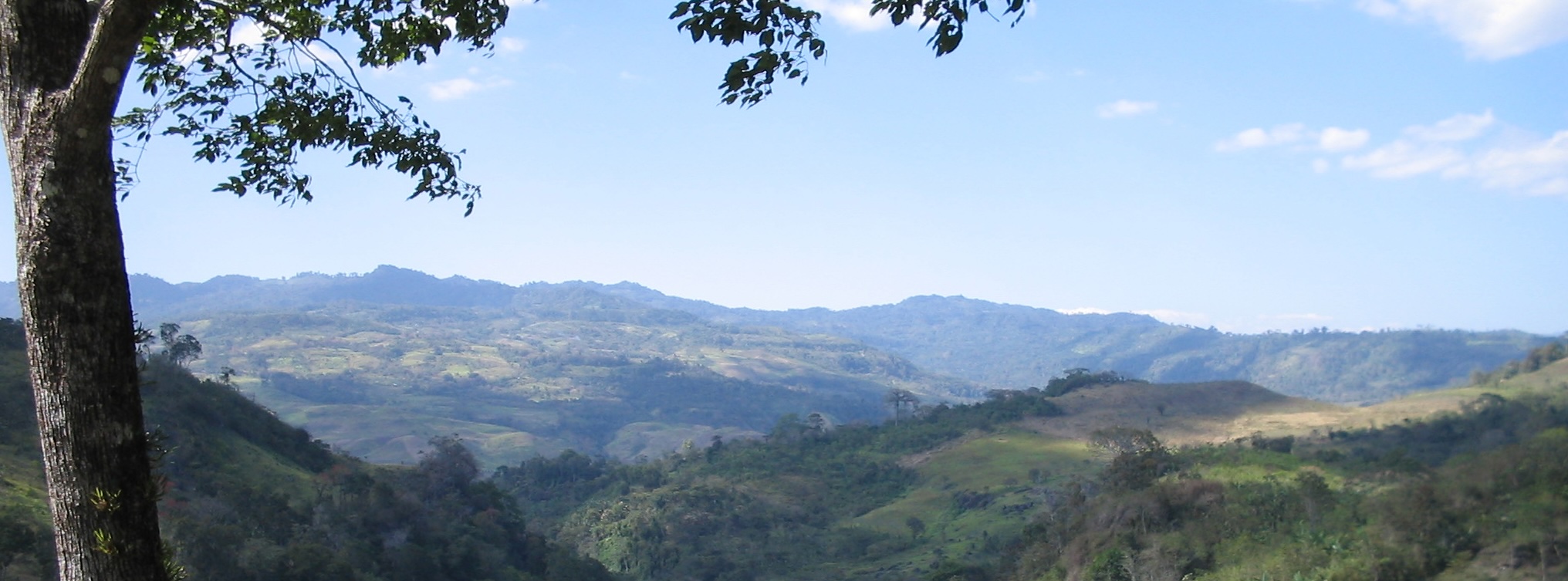
Protestants in Nicaragua has grown from three percent of the population in 1965 to as much as 30 percent today.
From the shade of a huge tree at the side of La Corona’s main road, Elsa Grandado Riva sells her tortillas filled with chicken, shredded cabbage and salsa. The money she makes supplements her husband’s meagre income derived from growing and selling fair trade coffee.
As she waits for the lunchtime rush to begin, Elsa chats with me about her life. Quickly, our conversation switches from coffee to the medical clinic that set up in town a day earlier. A group of Americans commandeered the school and erected two huge blue and white striped marquees that dominate the field between La Corona and the dirt road where we sit. Since then, villagers can talk of little else. I’ve come to La Corona in the heart of Nicaragua’s coffee country to learn about fair trade coffee. Little did I know that my education would have less to do with this agricultural crop than with a harvest of a different, loftier sort.
I was 21 years old and owned my own landscaping business. But I wanted more than to be a millionaire. And that’s when it happened.
When a tall American walks toward us, Elsa purses her lips, as is the Nicaraguan custom, and points with them in his direction, “He’s the boss,” she tells me. The tall American is Chip Carrier. Hailing from Franklin, Kentucky, Chip is here with the Baptist Medical & Dental Mission International and he’s a “servant of the Lord.”
“I preach the gospel,” he drawls.
He tells me that for the next week La Corona is home for 57 Americans, each of whom paid US$1,330 to be here. They sleep on cots in the school. There are doctors, dentists, nurses, administrators and others who help out as they can. Rather than being the boss, as Elsa told me, Chip is one of three preachers.
“At home I don’t preach. I own a farm. Raise Tennessee Walking horses. Last year I sold one for $100,000. The Lord has given me an eye for it [horses],” he explains.
“Why are you here in La Corona?” I want to know.
“Last year we set up a clinic not far from here in Santa Amelia. A woman from La Corona came to Santa Amelia and we gave her a wheelchair. She asked us to come to La Corona.
“All the community has to do is give up their school for a week. They pay nothing. This is one of 17 missions we’re bringing to Nicaragua this year,” explains Chip.
With this information, my experience in this remote Central American country begins to make sense. I’ve run into missionaries everywhere I’ve traveled. I sat with missionaries on the plane from Miami and I’ve seen dozens of evangelical churches even though Nicaragua is a predominantly Catholic country.
The U.S. Library of Congress reports that the number of Protestants (non-Catholics, really) in Nicaragua has grown from three percent of the population in 1965 to as much as 30 percent today. There’s no doubt that Nicaragua is a target for evangelical churches interested in increasing their numbers worldwide.
“What do you do in the clinic?” I ask Chip.
“We’ll see 4,000 people this week. Many have headaches or stomach aches. The kids have parasites. We’ll hand out 30,000 prescriptions and our three dentists will pull 1,000 teeth. We perform minor surgery. We bring 5,000 pairs of eyeglasses collected by the Lions Clubs.”
“Is the medical mission part of the Baptist church?” I ask.
“No, it’s independent. Charlie and Carolyn Herrington started it in Mississippi in 1974. Charlie died, and now Carolyn runs it.” Chip seems to expect me to recognize the Herrington name.
It might be a medical clinic, but over the week he figures that between 400 and 600 people will convert.
“Usually we get about ten percent.”
“Why do they do it?”
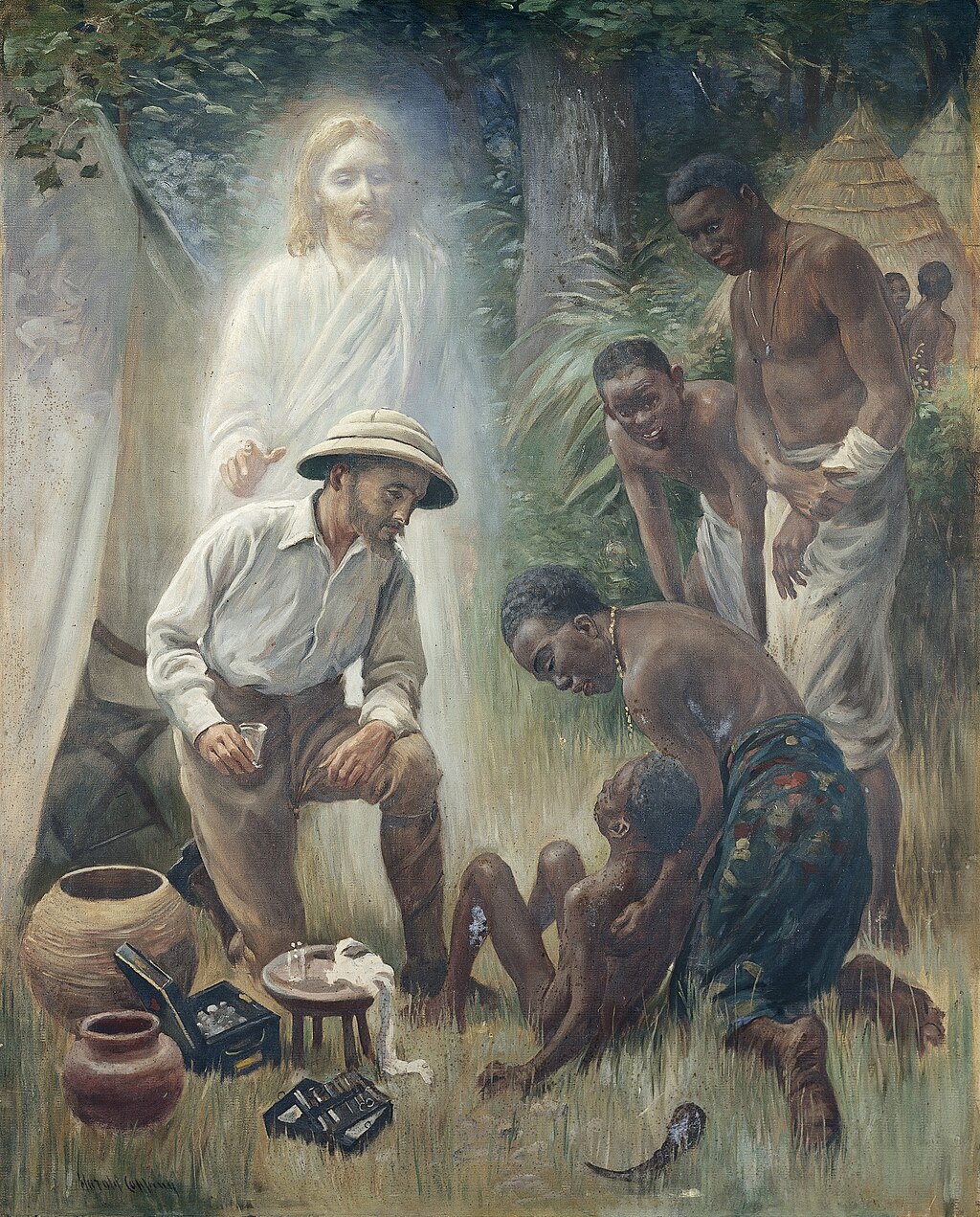
A medical missionary attending to a sick African. Oil painting by Harold Copping, 1930. Wellcome Museum. [o]
![[o]](https://commons.wikimedia.org/wiki/File:A_medical_missionary_attending_to_a_sick_African._Oil_painti_Wellcome_L0032737.jpg)
“People convert because that’s the only way they’ll get to heaven. As the Bible says, to get to heaven you must believe that Jesus died on the cross,” he explains.
“We’re seed planters,” says Chip. “Someone else will reap the harvest.”
I’m not quite done with my questions, but Chip excuses himself explaining that he has to get ready to give the first sermon of the day. He invites me to attend. I thank him. Minutes later, a young man with a square jaw and an apple pie complexion struts over. He should be wearing denim overalls and have a piece of straw between his teeth.
Blond and freckled, Tre Faulkner declares, “I hear you want to speak to me.”
He kicks off the conversation, “I’m 27 and a professional preacher. I’ve preached all over the world. If you visit my website: www.eternalvision.org. I’ll send you a Bible.”
I start taking notes.
“I practice abstinence,” he volunteers.
It occurs to me that I’m the closest thing to media Tre Faulkner is going to find in La Corona and it would be impossible for him to resist striking up a conversation.
“Who pays for you to be here?” I ask.
“I’m not a money preacher,” says Tre. “People who believe in the message that God has laid on my heart, they support us financially.”
When he sees I’m writing this down he repeats it twice.
“I’ve just returned from preaching in Africa. In a few weeks I’ll be preaching on worldwide TV. They’ve got 25-million viewers on TCT Alive.”
“How did you get into preaching?”
Tre tells me that not long ago he was making $300,000 a year. “I was 21 years old and owned my own landscaping business. But I wanted more than to be a millionaire. So I made a prayer to God. I told him I wanted more. And that’s when it happened.”
“That’s when you were converted?”
“Yes. I wasn’t exactly struck down but it was very vivid. You can’t get to God without going through Jesus,” he explains, and then adds, “Muslims are all lost.”
I feel like I’m taking notes for Evangelism 101. Though I’d come to La Corona to learn about fair trade coffee, it’s becoming apparent that someone – God maybe? – has other plans.
“Where do you meet with the greatest success?” I ask him.
“You mean souls? Where do I save the most souls?”
“Yes, I suppose that’s what I’m asking.”
“Africa,” he says without hesitation. “The Africans are the most open.”
As I inhale before posing my next question, Tre invites me to visit the clinic. Even though he’s already asked me not to include an earlier reference to minorities “unless he has a chance to explain in length what he meant by it,” Tre says, “You’ll be able to get in with your white skin.”
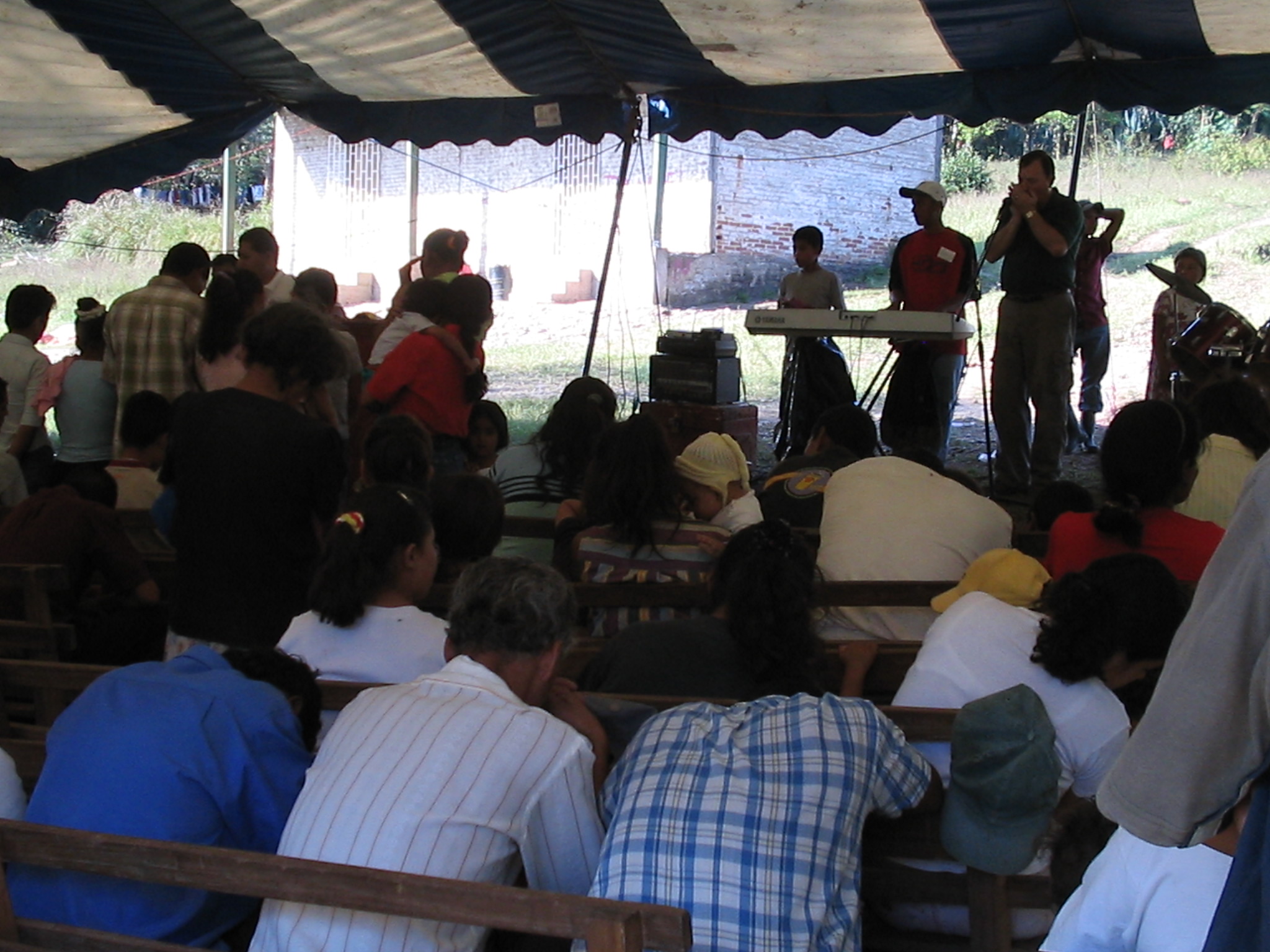
Under a tent Tre and his team administer tot he locals needing medical help. Photograph by Nicola Ross.
We wander over to the school past a long line up of Nicaraguans. At the gate, two Americans check for blue cards. Everyone in line has one. The clinic may not charge a fee, but its services aren’t exactly unfettered. To gain entrance, a person must have a stamp on his or her blue card. To get the prerequisite stamp they have to attend one of the sermons given by Chip, Tre or another preacher. Sermons are held several times a day under one of the blue and white marquees. They last for 30 minutes or longer.
As Tre predicted, I’m welcome to have a look around. First we visit the kitchen. Tre introduces me to half a dozen men and women who prepare meals. “Won’t you join us for lunch?” they ask. “We bring all our food with us.” Sliced white bread and processed cheese sandwiches with pickles and a foil pack of chips are on the menu. I decline.
Next he takes me to the classroom where they register patients and determine what kind of treatment is needed. Everything is neat, tidy, orderly. In the surgery, a woman has just had a cyst removed from above her right eyebrow. A Nicaraguan doctor is stitching her up. He is also a volunteer. His assistant, a nurse from the U.S., mops the blood. The nurse tells me that this type of surgery is routine.
In the far corner of the room Gordon Bray is hard at work. A dentist, he’s busy extracting two molars from a young woman. She’s been frozen but her hands twitch with tension.
We move on to the eye clinic. Charlie Gaddis and his wife are from Kentucky. They are clearly thrilled to have someone to show off to. Charlie tells me he’s not a doctor but he knows how to operate the instrument that measures vision. He’s working with an older woman; osteoporosis has given her a sizable Dowager’s Hump. I ask Charlie if she’ll receive glasses and if so, can I stay around and watch. Having poor vision myself, I’m intrigued to see the expression on her wrinkled face when she can see clearly for perhaps the first time in her life. I imagine her excitement at being able to see her grandchildren from a distance.
I’m welcome to stay, but Charlie tells me she’s only getting glasses to correct her close up vision. Without a hint of a smile he adds, “The older people need magnifiers so they can read the Bible.” I wonder what the chances are that this woman can actually read.
Kids are de-wormed, vaccinated and given used toys and clothing from an enormous stockpile of donated goods. The last stop is the pharmacy where, if Chip’s numbers are correct, patients receive in the order of seven prescriptions each. Everything is well organized. All patients are given a time for their appointment. The line-ups are long, but they move methodically from the church service to the clinic. The Americans are cheerful and clearly pleased to be helping out.
As we leave the school, Tre invites me to come to the sermon that night to hear him preach. Although there are several services each day, the seven p.m. time slot is special. The people who attend come of their own choosing rather than to get their card stamped on their way into the clinic.
I accompany Maria who carries her infant daughter. I’m living with Maria, her husband, his parents and brother in their dirt floor home on a small coffee farm just outside the village. Maria makes the ten-minute journey into La Corona decked out in her Sunday best. I learn that attending church is one of the outings available to local women. When we arrive, I notice that most seats are filled by children, their mothers and grandmothers. Neighbours, these women chat animatedly amongst themselves as we wait for the evening’s “performance” to begin. Kids chase each other through the tent and scramble aboard a small pickup truck that’s parked nearby. There is no church-like hush.
If Tre doesn’t keep his number of converts up, he won’t be invited back. Souls are currency in the evangelical business.
The night begins with a special treat for the children who make up at least half the 150 or so people who sit on wooden benches. Several clowns clad in bright clothing and happy painted faces descend on the audience. They hand out balloons to the startled youngsters and lead a few songs. Then they invite all the children to accompany them to the separate children’s church. Only half the kids are led away. The others ignore the invitation. Some sit, but most continue to play.
With a Nicaraguan translator flanking his side, Tre makes a grand entrance that’s meant to capture the attention of the distracted crowd. Speaking into a cordless microphone, Tre starts out quietly but soon raises his voice so he can be heard over the squealing kids. His Nicaraguan translator matches his every move. When Tre steps right, his shadow follows; when Tre throws up his hands in despair at the plight of sinners, so mimics his translator. He gives Tre’s fire and brimstone speech a Nicaraguan face. I notice that his choice of words sometimes softens the sting of Tre’s message.
At the end of a 30-minute fiery sermon about sex, adultery, incest and death (It’s no wonder the kids were siphoned off.), Tre lowers his voice. Quietly, he admonishes the audience -- he calls us sinners. He’s not mad, he explains, instead, he’s sorry. He’s sorry for each and everyone one of us. He’s sorry that we’re laughing and talking while he’s bringing us the word of Jesus, and obvious that he isn’t happy when he doesn’t have his congregation’s undivided attention. The size of his night’s “harvest” likely depends on our hanging on to his every word. I presume that if Tre doesn’t keep his number of converts up, he won’t be invited back. Souls are currency in the evangelical business.
He harvests ten souls. That, we’re informed, is on top of the 48 from the night before. I can’t help but think Tre looks disappointed with his haul. The ten converts line up at the front of the marquee and shake hands with Tre and his translator. Chip is also on hand to congratulate them. We all clap as each convert receives a new paperback Bible. Afterwards they wait around looking lost. I get the feeling they expected a bigger celebration to mark this momentous occasion.
Are these people, I wonder, part of the 30 percent of Nicaraguans considered to be Protestants?
With Tre’s sermon complete and the converts counted, the night’s performance ends. The audience mingles for a while, not yet ready to head home. First one and then another of the American missionaries comes over to talk to me. “What are you doing here?” they want to know. “We’re so glad you came out tonight. Come again.”
I follow Maria to the road where her husband waits with a flashlight so he can accompany us home. The young couple wish neighbours goodnight and we’re on our way. There is lots of talk about who has what malady and which children received what toys.
The next morning I return to La Corona. I’m sitting in the shade of the marquee when another American approaches me. “Como te llamas?” he asks. I give him my name and ask, in Spanish, where he’s from. Red-faced he tells me his name is Chico. He explains that he has just exhausted the extent of his Spanish and apologizes for not having a better grasp on the language. Chico is about 40 and lives in Kentucky and comes on these missions several times a year.
As he sits down, four Nicaraguan boys swarm him. One has rotten front teeth. Mucous crusts the nostrils of another. All wear lopsided clothing that’s ripped and stained. Obviously they know Chico. Recognize him as one of the clowns from the previous night. They like that they can pronounce his name — it’s written in gold across the front of his bright T-shirt. Chico, his eyes clear and blue, has a vivid orange kerchief knotted at his tanned neck. He wraps his arm around the snotty-nosed kid and gives him a bear hug. There are high-fives all round. They speak different languages but it’s clear that Chico has no trouble communicating with these youngsters.
As the tent fills up with the next shift of blue card-carrying Nicaraguans, Chico excuses himself and makes his way to the front of the marquee. On stage he picks up a mandolin that he plays enthusiastically as Chip gives the first sermon of the day. ō

NICOLA ROSS is a journalist and the author of a series of hiking guides, Loops & Lattes and 40 Days & 40 Hikes: Loving the Bruce Trail One Loop at a Time. Her articles have been published in The Walrus, The Globe and Mail, Explore, Bruce Trail magazine, Mountain Life, Avenue, Ontario Nature and this publication. Nicola lives atop the Niagara Escarpment in Caledon, Ontario.
Add new comment