
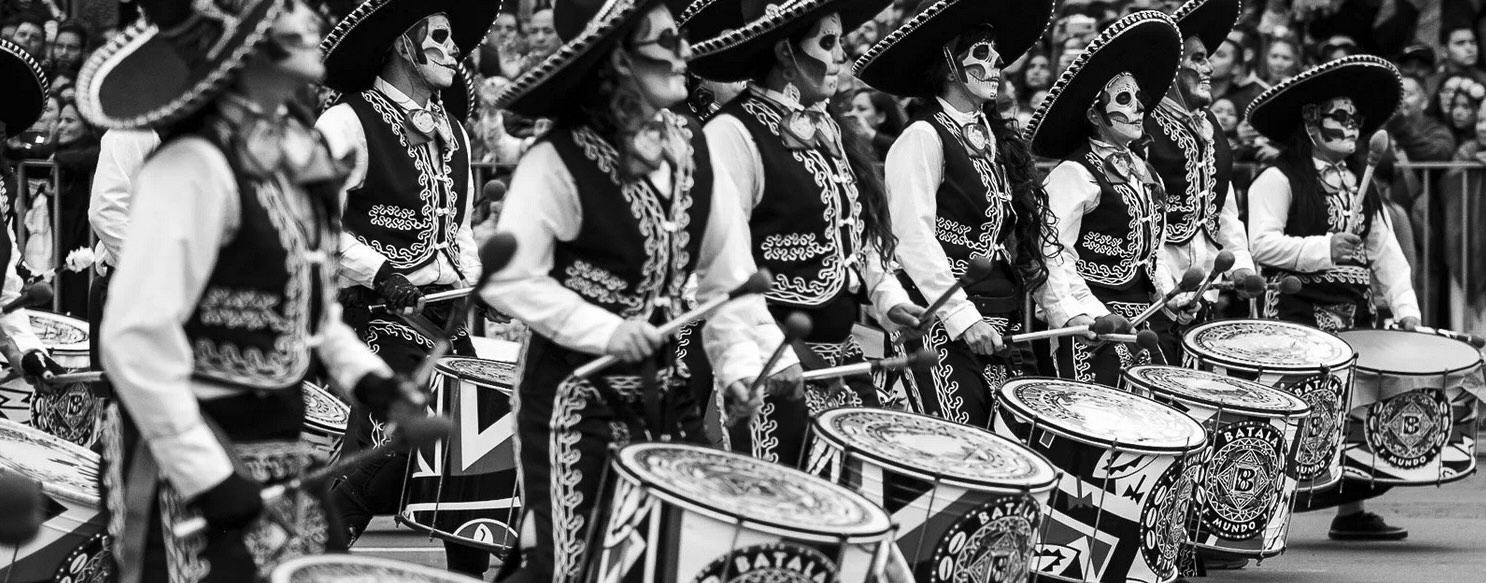
Parading Day of the Dead drummers. Photograph by Frederik Trovatten. [o]
The solitary Mexican loves fiestas and public gatherings. Any occasion for getting together will serve, any pretext to stop the flow of time and commemorate men and events with festivals and ceremonies. We are a ritual people, and this characteristic enriches both our imaginations and our sensibilities, which are equally sharp and alert. The art of the fiesta has been debased almost everywhere else, but not in Mexico. There are few places in the world where it is possible to take part in a spectacle like our great religious fiestas with their violent primary colors, their bizarre costumes and dances, their fireworks and ceremonies, and their inexhaustible welter of surprises: the fruit, candy, toys and other objects sold on these days in the plazas and open-air markets.
Our calendar is crowded with fiestas. There are certain days when the whole country, from the most remote villages to the largest cities, prays, shouts, feasts, gets drunk and kills, in honour of the Virgin of Guadalupe or Benito Juarez. Each year on the fifteenth of September, at eleven o'clock at night, we celebrate the fiesta of the Grito1 in all the plazas of the Republic, and the excited crowds actually shout for a whole hour . . . the better, perhaps, to remain silent for the rest of the year. During the days before and after the twelfth of December2, time comes to a full stop, and instead of pushing us toward a deceptive tomorrow that is always beyond our reach, offers us a complete and perfect today of dancing and revelry, of communion with the most ancient and secret Mexico. Time is no longer succession, and becomes what it originally was and is: the present, in which past and future are reconciled.
Death is a mirror which reflects the vain gesticulations of the living.
But the fiestas which the Church and State provide for the country as a whole are not enough. The life of every city and village is ruled by a patron saint whose blessing is celebrated with devout regularity. Neighborhoods and trades also have their annual fiestas, their ceremonies and fairs. And each one of us — atheist, Catholic, or merely indifferent — has his own saint's day, which he observes every year. It is impossible to calculate how many fiestas we have and how much time and money we spend on them. I remember asking the mayor of a village near Mitla, several years ago, "What is the income of the village government?" "About 3,000 pesos a year. We are very poor. But the Governor and the Federal Government always help us to meet our expenses." "And how are the 3,000 pesos spent?" "Mostly on fiestas, señor. We are a small village, but we have two patron saints.”
This reply is not surprising. Our poverty can be measured by the frequency and luxuriousness of our holidays. Wealthy countries have very few: there is neither the time nor the desire for them, and they are not necessary. The people have other things to do, and when they amuse themselves they do so in small groups. The modern masses are agglomerations of solitary individuals. On great occasions in Paris or New York, when the populace gathers in the squares or stadiums, the absence of people, in the sense of a people, is remarkable: there are couples and small groups, but they never form a living community in which the individual is at once dissolved and redeemed. But how could a poor Mexican live without the two or three annual fiestas that make up for his poverty and misery? Fiestas are our only luxury. They replace, and are perhaps better than, the theatre and vacations, Anglo-Saxon weekends and cocktail par ties, the bourgeois reception, the Mediterranean cafe.
In all of these ceremonies — national or local, trade or family — the Mexican opens out. They all give him a chance to reveal himself and to converse with God, country, friends or relations. During these days the silent Mexican whistles, shouts, sings, shoots off fireworks, discharges his pistol into the air. He discharges his soul. And his shout, like the rockets we love so much, ascends to the heavens, explodes into green, red, blue, and white lights, and falls dizzily to earth with a trail of golden sparks. This is the night when friends who have not exchanged more than the prescribed courtesies for months get drunk together, trade confidences, weep over the same troubles, discover that they are brothers, and sometimes, to prove it, kill each other. The night is full of songs and loud cries. The lover wakes up his sweetheart with an orchestra. There are jokes and conversations from balcony to balcony, sidewalk to sidewalk. Nobody talks quietly. Hats fly in the air. Laughter and curses ring like silver pesos. Guitars are brought out. Now and then, it is true, the happiness ends badly, in quarrels, insults, pistol shots, stabbings. But these too are part of the fiesta, for the Mexican does not seek amusement: he seeks to escape from himself, to leap over the wall of solitude that confines him during the rest of the year. All are possessed by violence and frenzy. Their souls explode like the colors and voices and emotions. Do they forget them selves and show their true faces? Nobody knows. The important thing is to go out, open a way, get drunk on noise, people, colors. Mexico is celebrating a fiesta. And this fiesta, shot through with lightning and delirium, is the brilliant reverse to our silence and apathy, our reticence and gloom.
According to the interpretation of French sociologists, the fiesta is an excess, an expense. By means of this squandering the community protects itself against the envy of the gods or of men. Sacrifices and offerings placate or buy off the gods and the patron saints. ·wasting money and expending energy affirms the community's wealth in both. This luxury is a proof of health, a show of abundance and power. Or a magic trap. For squandering is an effort to attract abundance by contagion. Money calls to money. When life is thrown away it increases; the orgy, which is sexual expenditure, is also a ceremony of regeneration; waste gives strength. New Year celebrations, in every culture, signify something beyond the mere observance of a date on the calendar. The day is a pause: time is stopped, is actually annihilated. The rites that celebrate its death are intended to provoke its rebirth, because they mark not only the end of an old year but also the beginning of a new. Everything attracts its opposite. The fiesta's function, then, is more utilitarian than we think: waste attracts or promotes wealth, and is an investment like any other, except that the returns on it cannot be measured or counted. What is sought is potency, life, health. In this sense the fiesta, like the gift and the offering, is one of the most ancient of economic forms.
This interpretation has always seemed to me to be incomplete. The fiesta is by nature sacred, literally or figuratively, and above all it is the advent of the unusual. It is governed by its own special rules, that set it apart from other days, and it has a logic, an ethic and even an economy that are often in conflict with everyday norms. It all occurs in an enchanted world: time is transformed to a mythical past or a total present; space, the scene of the fiesta, is turned into a gaily decorated world of its own; and the persons taking part cast off all human or social rank and become, for the moment, living images. And everything takes place as if it were not so, as if it were a dream. But whatever happens, our actions have a greater lightness, a different gravity. They take on other meanings and with them we contract new obligations. We throw down our burdens of time and reason.
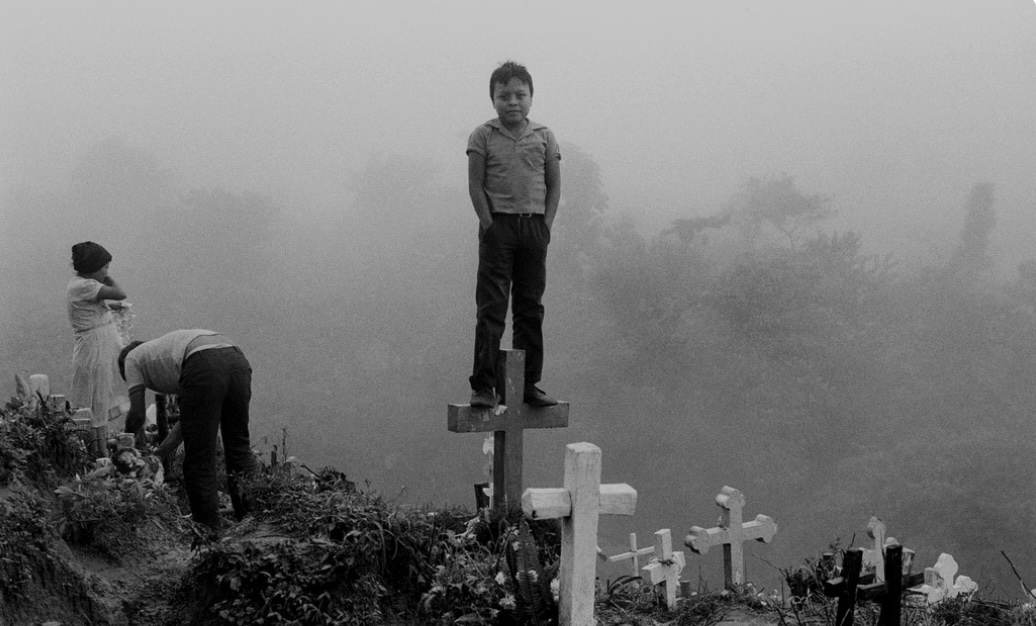
Day of the Dead, Guatemala, 1980. Photography by Jean Gaumy, Magnum. [o]
In certain fiestas the very notion of order disappears. Chaos comes back and license rules. Anything is permitted: the customary hierarchies vanish, along with all social, sex, caste, and trade distinctions. Men disguise themselves as women, gentlemen as slaves, the poor as the rich. The army, the clergy, and the law are ridiculed. Obligatory sacrilege, ritual profanation is committed. Love becomes promiscuity. Sometimes the fiesta becomes a Black Mass. Regulations, habits and customs are violated. Respectable people put away the dignified expressions and conservative clothes that isolate them, dress up in gaudy colors, hide behind a mask, and escape from themselves.
Therefore the fiesta is not only an excess, a ritual squandering of the goods painfully accumulated during the rest of the year; it is also a revolt, a sudden immersion in the formless, in pure being. By means of the fiesta society frees itself from the norms it has established. It ridicules its gods, its principles, and its laws: it denies its own self.
The fiesta is a revolution in the most literal sense of the word. In the confusion that it generates, society is dissolved, is drowned, insofar as it is an organism ruled according to certain laws and principles. But it drowns in itself, in its own original chaos or liberty. Everything is united: good and evil, day and night, the sacred and the profane. Everything merges, loses shape and individuality and returns to the primordial mass. The fiesta is a cosmic experiment, an experiment in disorder, reuniting contradictory elements and principles in order to bring about a renascence of life. Ritual death promotes a rebirth; vomiting increases the appetite; the orgy, sterile in itself, renews the fertility of the mother or of the earth. The fiesta is a return to a remote and undifferentiated state, pre-natal or pre-social. It is a return that is also a beginning, in accordance with the dialectic that is inherent in social processes.
The group emerges purified and strengthened from this plunge into chaos. It has immersed itself in its own origins, in the womb from which it came. To express it in another way, the fiesta denies society as an organic system of differentiated forms and principles, but affirms it as a source of creative energy. It is a true "re-creation," the opposite of the "recreation" characterizing modem vacations, which do not entail any rites or ceremonies whatever and are as individualistic and sterile as the world that invented them.
Society communes with itself during the fiesta. Its members return to original chaos and freedom. Social structures break down and new relationships, unexpected rules, capricious hierarchies are created. In the general disorder everybody forgets himself and enters into otherwise forbidden situations and places. The bounds between audience and actors, officials and servants, are erased. Everybody takes part in the fiesta, everybody is caught up in its whirlwind. Whatever its mood, its character, its meaning, the fiesta is participation, and this trait distinguishes it from all other ceremonies and social phenomena. Lay or religious, orgy or saturnalia, the fiesta is a social act based on the full participation of all its celebrants.
Thanks to the fiesta the Mexican opens out, participates, communes with his fellows and with the values that give meaning to his religious or political existence. And it is significant that a country as sorrowful as ours should have so many and such joyous fiestas. Their frequency, their brilliance and excitement, the enthusiasm with which we take part, all suggest that without them we would explode. They free us, if only momentarily, from the thwarted impulses, the inflammable desires that we carry within us. But the Mexican fiesta is not merely a return to an original state of formless and normless liberty: the Mexican is not seeking to return, but to escape from himself, to exceed himself. Our fiestas are explosions. Life and death, joy and sorrow, music and mere noise are united, not to re-create or recognize themselves, but to swallow each other up. There is nothing so joyous as a Mexican fiesta, but there is also nothing so sorrowful. Fiesta night is also a night of mourning.
If we hide within ourselves in our daily lives, we discharge ourselves in the whirlwind of the fiesta. It is more than an opening out: we rend ourselves open. Everything — music, love, friendship — ends in tumult and violence. The frenzy of our festivals shows the extent to which our solitude closes us off from communication with the world. We are familiar with delirium, with songs and shouts, with the monologue . . . but not with the dialogue. Our fiestas, like our confidences, our loves, our attempts to reorder our society, are violent breaks with the old or the established. Each time we try to express ourselves we have to break with ourselves. And the fiesta is only one example, perhaps the most typical, of this violent break. It is not difficult to name others, equally revealing: our games, which are always going to extremes, often mortal; our profligate spending, the reverse of our timid investments and business enterprises; our confessions. The somber Mexican, closed up in himself, suddenly explodes, tears open his breast and reveals himself, though not without a certain complacency, and not without a stopping place in the shameful or terrible mazes of his intimacy. We are not frank, but our sincerity can reach extremes that horrify a European. The explosive, dramatic, sometimes even suicidal manner in which we strip ourselves, surrender ourselves, is evidence that something inhibits and suffocates us. Something impedes us from being. And since we cannot or dare not confront our own selves, we resort to the fiesta. It fires us into the void; it is a drunken rapture that bums itself out, a pistol shot in the air, a skyrocket.
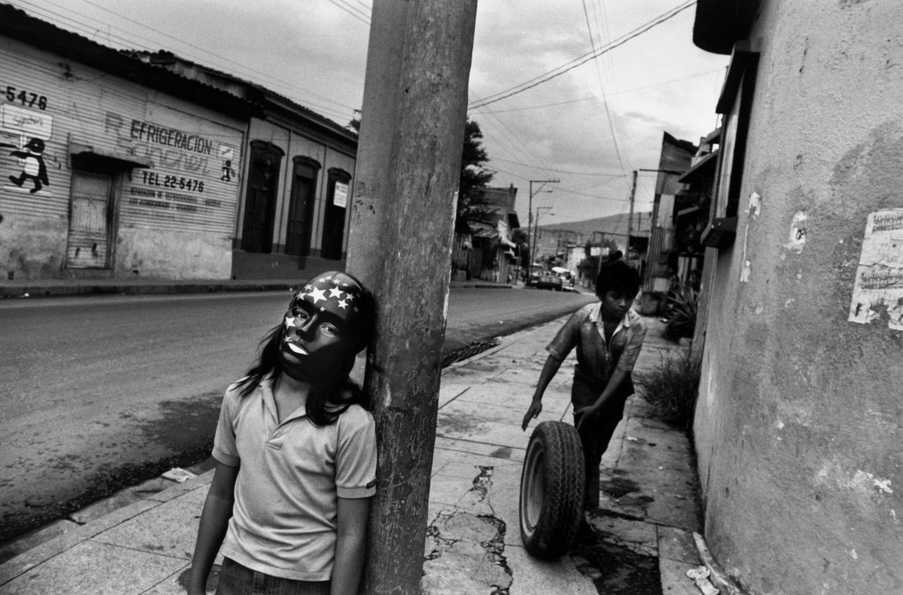
Child with starred mask during Day of the Dead. 1992. El Salvador, Sans Salvador. [o]
Death is a mirror which reflects the vain gesticulations of the living. The whole motley confusion of acts, omissions, regrets and hopes which is the life of each one of us finds in death, not meaning or explanation, but an end. Death defines life; a death depicts a life in immutable forms; we do not change except to disappear. Our deaths illuminate our lives. If our deaths lack meaning, our lives also lacked it. Therefore we are apt to say, when somebody has died a violent death, "He got what he was looking for." Each of us dies the death he is looking for, the death he has made for himself. A Christian death or a dog's death are ways of dying that reflect ways of living. If death betrays us and we die badly, everyone laments the fact, because we should die as we have lived. Death, like life, is not transferable. If we do not die as we lived, it is because the life we lived was not really ours: it did not belong to us, just as the bad death that kills us does not belong to us. Tell me how you die and I will tell you who you are.
The opposition between life and death was not so absolute to the ancient Mexicans as it is to us. Life extended into death, and vice versa. Death was not the natural end of life but one phase of an infinite cycle. Life, death and resurrection were stages of a cosmic process which repeated itself continuously. Life had no higher function than to flow into death, its opposite and complement; and death, in turn, was not an end in itself: man fed the insatiable hunger of life with his death. Sacrifices had a double purpose: on the one hand man participated in the creative process, at the same time paying back to the gods the debt contracted by his species; on the other hand he nourished cosmic life and also social life, which was nurtured by the former.
Perhaps the most characteristic aspect of this conception is the impersonal nature of the sacrifice. Since their lives did not belong to them, their deaths lacked any personal meaning. The dead — including warriors killed in battle and women dying in childbirth, companions of Huitzilopochtli the sun god — disappeared at the end of a certain period, to return to the undifferentiated country of the shadows, to be melted into the air, the earth, the fire, the animating substance of the universe. Our indigenous ancestors did not believe that their deaths belonged to them, just as they never thought that their lives were really theirs in the Christian sense. Everything was examined to determine, from birth, the life and death of each man: his social class, the year, the place, the day, the hour. The Aztec was as little responsible for his actions as for his death.
Space and time were bound together and formed an inseparable whole. There was a particular "time" for each place, each of the cardinal points and the center in which they were immobilized. And this complex of space-time possessed its own virtues and powers, which profoundly influenced and determined human life. To be born on a certain day was to pertain to a place, a time, a color and a destiny. All was traced out in advance. Where we dissociate space and time, mere stage sets for the actions of our lives, there were as many "space-times" for the Aztecs as there were combinations in the priestly calendar, each one endowed with a particular qualitative significance, superior to human will.
Religion and destiny ruled their lives, as morality and freedom rule ours. We live under the sign of liberty, and everything — even Greek fatality and the grace of the theologians — is election and struggle, but for the Aztecs the problem reduced itself to investigating the never-clear will of the gods. Only the gods were free, and only they had the power to choose — and therefore, in a profound sense, to sin. The Aztec religion is full of great sinful gods — Quetzalcóatl is the major example — who grow weak and abandon their believers, in the same way that Christians sometimes deny God. The conquest of Mexico would be inexplicable without the treachery of the gods, who denied their own people.
The advent of Catholicism radically modified this situation. Sacrifice and the idea of salvation, formerly collective, became personal. Freedom was humanized, embodied in man. To the ancient Aztecs the essential thing was to assure the continuity of creation; sacrifice did not bring about salvation in another world, but cosmic health; the universe, and not the individual, was given life by the blood and death of human beings. For Christians it is the individual who counts. The world — history, society — is condemned beforehand. The death of Christ saved each man in particular. Each one of us is Man, and represents the hopes and possibilities of the species. Redemption is a personal task.
Both attitudes, opposed as they may seem, have a common note: life, collective or individual, looks forward to a death that in its way is a new life. Life only justifies and transcends itself when it is realized in death, and death is also a transcendence, in that it is a new life. To Christians death is a transition, a somersault between two lives, the temporal and the otherworldly; to the Aztecs it was the profoundest way of participating in the continuous regeneration of the creative forces, which were always in danger of being extinguished if they were not provided with blood, the sacred food. In both systems life and death lack autonomy, are the two sides of a single reality. They are references to the invisible realities.
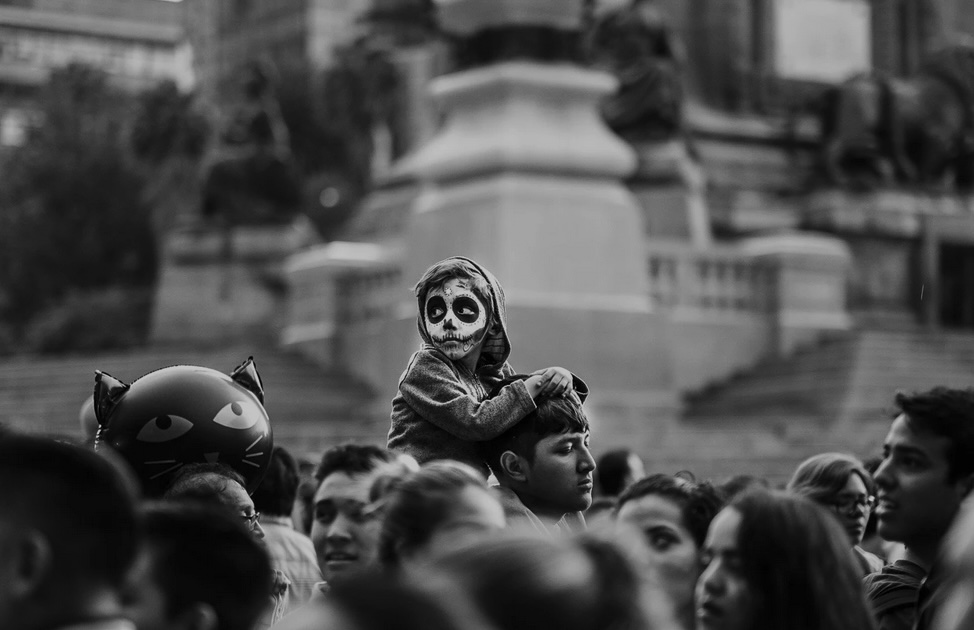
Boy in Day of the Dead mask. Photography by Frederik Trovatten. [o]
Modern death does not have any significance that transcends it or that refers to other values. It is rarely anything more than the inevitable conclusion of a natural process. In a world of facts, death is merely one more fact. But since it is such a disagreeable fact, contrary to all our concepts and to the very meaning of our lives, the philosophy of progress ("Progress toward what, and from what?" Scheler asked) pretends to make it disappear, like a magician palming a coin. Everything in the modern world functions as if death did not exist. Nobody takes it into account, it is suppressed everywhere: in political pronouncements, commercial advertising, public morality and popular customs; in the promise of cut-rate health and happiness offered to all of us by hospitals, drugstores and playing fields. But death enters into everything we undertake, and it is no longer a transition but a great gaping mouth that nothing can satisfy. The century of health, hygiene and contraceptives, miracle drugs and synthetic foods, is also the century of the concentration camp and the police state, Hiroshima and the murder story. Nobody thinks about death, about his own death, as Rilke asked us to do, because nobody lives a personal life. Collective slaughter is the fruit of a collectivized way of life.
Death also lacks meaning for the modern Mexican. It is no longer a transition, an access to another life more alive than our own. But although we do not view death as a transcendence, we have not eliminated it from our daily lives. The word death is not pronounced in New York, in Paris, in London, because it burns the lips. The Mexican, in contrast, is familiar with death, jokes about it, caresses it, sleeps with it, celebrates it; it is one of his favorite toys and his most steadfast love. True, there is perhaps as much fear in his attitude as in that of others, but at least death is not hidden away: he looks at it face to face, with impatience, disdain or irony. "If they are going to kill me tomorrow, let them kill me right away.”3
The Mexican's indifference toward death is fostered by his indifference toward life. He views not only death but also life as non-transcendent. Our songs, proverbs, fiestas and popular beliefs show very clearly that the reason death cannot frighten us is that "life has cured us of fear." It is natural, even desirable, to die, and the sooner the better. We kill because life — our own or another's — is of no value. Life and death are inseparable, and when the former lacks meaning, the latter becomes equally meaningless. Mexican death is the mirror of Mexican life. And the Mexican shuts himself away and ignores both of them.
Our contempt for death is not at odds with the cult we have made of it. Death is present in our fiestas, our games, our loves and our thoughts. To die and to kill are ideas that rarely leave us. We are seduced by death. The fascination it exerts over us is the result, perhaps, of our hermit-like solitude and of the fury with which we break out of it. The pressure of our vitality, which can only express itself in forms that betray it, explains the deadly nature, aggressive or suicidal, of our explosions. When we explode we touch against the highest point of that tension, we graze the very zenith of life. And there, at the height of our frenzy, suddenly we feel dizzy: it is then that death attracts us.
Another factor is that death revenges us against life, strips it of all its vanities and pretensions and converts it into what it really is: a few neat bones and a dreadful grimace. In a closed world where everything is death, only death has value. But our affirmation is negative. Sugar-candy skulls, and tissue-paper skulls and skeletons strung with fireworks . . . our popular images always poke fun at life, affirming the nothingness and insignificance of human existence. We decorate our houses with death's heads, we eat bread in the shape of bones on the Day of the Dead, we love the songs and stories in which death laughs and cracks jokes, but all this boastful familiarity does not rid us of the question we all ask: What is death? We have not thought up a new answer. And each time we ask, we shrug our shoulders: Why should I care about death if I have never cared about life?
Does the Mexican open out in the presence of death? He praises it, celebrates it, cultivates it, embraces it, but he never surrenders himself to it. Everything is remote and strange to him, and nothing more so than death. He does not surrender himself to it because surrender entails a sacrifice. And a sacrifice, in tum, demands that someone must give and someone receive. That is, someone must open out and face a reality that transcends him. In a closed, non-transcendent world, death neither gives nor receives: it consumes itself and is self-gratifying. Therefore our relations with death are intimate — more intimate, perhaps, than those of any other people — but empty of meaning and devoid of erotic emotion. Death in Mexico is sterile, not fecund like that of the Aztecs and the Christians.
Nothing is more opposed to this attitude than that of the Europeans and North Americans. Their laws, customs and public and private ethics all tend to preserve human life. This protection does not prevent the number of ingenious and refined murders, of perfect crimes and crime waves, from increasing. The professional criminals who plot their murders with a precision impossible to a Mexican, the delight they take in describing their experiences and methods, the fascination with which the press and public follow their confessions, and the recognized inefficiency of the systems of prevention, show that the respect for life of which Western civilization is so proud is either incomplete or hypocritical.
Fear makes us tum our backs on death, and by refusing to contemplate it we shut ourselves off from life . . .
The cult of life, if it is truly profound and total, is also the cult of death, because the two are inseparable. A civilization that denies death ends by denying life. The perfection of modern crime is not merely a consequence of modem technical progress and the vogue of the murder story: it derives from the contempt for life which is inevitably implicit in any attempt to hide death away and pretend it does not exist. It might be added that modern technical skills and the popularity of crime stories are, like concentration camps and collective extermination, the results of an optimistic and unilateral conception of existence. It is useless to exclude death from our images, our words, our ideas, because death will obliterate all of us, beginning with those who ignore it or pretend to ignore it.
When the Mexican kills — for revenge, pleasure or caprice — he kills a person, a human being. Modern criminals and states men do not kill: they abolish. They experiment with beings who have lost their human qualities. Prisoners in the concentration camps are first degraded, changed into mere objects; then they are exterminated en masse. The typical criminal in the large cities — beyond the specific motives for his crimes — realizes on a small scale what the modern leader realizes on a grand scale. He too experiments, in his own way: he poisons, destroys corpses with acids, dismembers them, converts them into objects. The ancient relationship between victim and murderer, which is the only thing that humanizes murder, that makes it even thinkable, has disappeared. As in the novels of Sade, there is no longer anything except torturers and objects, instruments of pleasure and destruction. And the nonexistence of the victim makes the infinite solitude of the murderer even more intolerable. Murder is still a relationship in Mexico, and in this sense it has the same liberating significance as the fiesta or the confession. Hence its drama, its poetry and — why not say it? — its grandeur. Through murder we achieve a momentary transcendence.
At the beginning of his eighth Duino Elegy, Rilke says that the "creature," in his condition of animal innocence, "beholds the open" . . . unlike ourselves, who never look forward, toward the absolute. Fear makes us tum our backs on death, and by refusing to contemplate it we shut ourselves off from life, which is a totality that includes it. The "open" is where contraries are reconciled, where light and shadow are fused. This conception restores death's original meaning: death and life are opposites that complement each other. Both are halves of a sphere that we, subjects of time and space, can only glimpse. In the prenatal world, life and death are merged; in ours, opposed; in the world beyond, reunited again, not in the animal innocence that precedes sin and the knowledge of sin, but as in innocence regained. Man can transcend the temporal opposition separating them (and residing not in them but in his own consciousness) and perceive them as a superior whole. This recognition can take place only through detachment: he must renounce his temporal life and his nostalgia for limbo, for the animal world. He must open himself out to death if he wishes to open himself out to life. Then he will be "like the angels.”
Thus there are two attitudes toward death: one, pointing forward, that conceives of it as creation; the other, pointing backward, that expresses itself as a fascination with nothingness or as a nostalgia for limbo. No Mexican or Spanish-American poet, with the possible exception of Cesar Vallejo, approaches the first of these two concepts. The absence of a mystic — and only a mystic is capable of offering insights like those of Rilke — indicates the extent to which modern Mexican culture is in sensible to religion. But two Mexican poets, Jose Gorostiza and Xavier Villaurrutia, represent the second of these two attitudes. For Gorostiza life is a "death without end," a perpetual falling into nothingness; for Villaurrutia it is no more than a "nostalgia for death.”
The phrase that Villaurrutia chose for his book, Nostalgia de la Muerte, is not merely a lucky hit. The author has used it in order to tell us the ultimate meaning of his poetry. Death as nostalgia, rather than as the fruition or end of life, is death as origin. The ancient, original source is a bone, not a womb. This statement runs the risk of seeming either an empty paradox or an old commonplace: "For thou art dust, and unto dust shalt thou return." I believe that the poet hopes to find in death ( which is, in effect, our origin ) a revelation that his temporal life has denied him: the true meaning of life. When we die,
The second hand will race around its dial, all will be contained in an instant . . . and perhaps it will be possible to live, even after death.
A return to original death would be a return to the life before life, the life before death: to limbo, to the maternal source.
Muerte sin Fin, the poem by Jose Gorostiza, is perhaps the best evidence we have in Latin America of a truly modern consciousness, one that is turned in upon itself, imprisoned in its own blinding clarity. The poet, in a sort of lucid fury, wants to rip the mask off existence in order to see it as it is. The dialogue between man and the world, which is as old as poetry and love, is transformed into a dialogue between the water and the glass that contains it, between the thought and the form into which it is poured and which it eventually corrodes. The poet warns us from his prison of appearances — trees and thoughts, stones and emotions, days and nights and twilights are all simply metaphors, mere colored ribbons — that the breath which informs matter, shaping it and giving it form, is the same breath that corrodes and withers and defeats it. It is a drama without personae, since all are merely reflections, the various disguises of a suicide who talks to himself in a language of mirrors and echoes, and the mind also is nothing more than a reflection of death, of death in love with itself. Everything is immersed in its own clarity and brilliance, everything is directed toward this transparent death: life is only a metaphor, an invention with which death — death too! — wants to deceive itself. The poem is a variation on the old theme of Narcissus, although there is no allusion to it in the text. And it is not only the consciousness that contemplates itself in its empty, transparent water (both mirror and eye at the same time, as in the Valéry poem): nothingness, which imitates form and life, which feigns corruption and death, strips itself naked and turns in upon itself, loves itself, falls into itself: a tireless death without end.
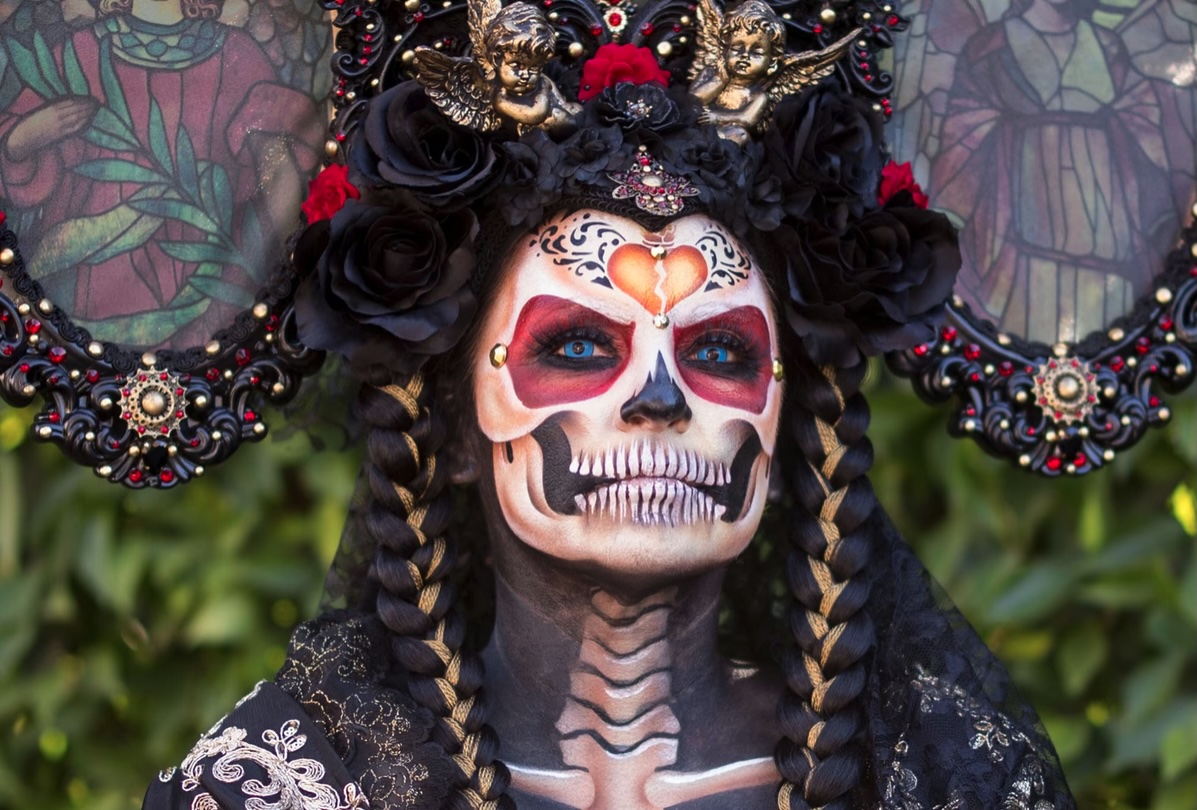
The Mexican holiday has spread as a cultural theme outside of Mexico. A participant at the 23rd Annual Día de los Muertos at Hollywood Forever on October 29, 2022, in Hollywood, California. Photo by Emma McIntyre/Getty/The Atlantic Magazine. [o]
If we open out during fiestas, then, or when we are drunk or exchanging confidences, we do it so violently that we wound ourselves. And we shrug our shoulders at death, as at life, confronting it in silence or with a contemptuous smile. The fiesta, the crime of passion and the gratuitous crime reveal that the equilibrium of which we are so proud is only a mask, always in danger of being ripped off by a sudden explosion of our intimacy.
All of these attitudes indicate that the Mexican senses the presence of a stigma both on himself and on the flesh of his country. It is diffused but none the less living, original, and ineradicable. Our gestures and expressions all attempt to hide this wound, which is always open, always ready to catch fire and burn under the rays of a stranger's glance.
Now, every separation causes a wound. Without stopping to investigate how and when the separation is brought about, I want to point out that any break (with ourselves or those around us, with the past or the present) creates a feeling of solitude. In extreme cases — separation from one's parents, matrix or native land, the death of the gods or a painful self-consciousness — solitude is identified with orphanhood. And both of them generally manifest themselves as a sense of sin. The penalties and guilty feelings inflicted by a state of separation can be considered, thanks to the ideas of expiation and redemption, as necessary sacrifices, as pledges or promises of a future communion that will put an end to the long exile. The guilt can vanish, the wound heal over, the separation resolve itself in communion. Solitude thus assumes a purgative, purifying character. The solitary or isolated individual transcends his solitude, accepting it as a proof or promise of communion.
The Mexican does not transcend his solitude. On the contrary, he locks himself up in it. We live in our solitude like Philoctetes on his island, fearing rather than hoping to return to the world. We cannot bear the presence of our companions. We hide within ourselves — except when we rend ourselves open in our frenzy — and the solitude in which we suffer has no reference either to a redeemer or a creator. We oscillate between intimacy and withdrawal, between a shout and a silence, between a fiesta and a wake, without ever truly surrendering ourselves. Our indifference hides life behind a death mask; our wild shout rips off this mask and shoots into the sky, where it swells, explodes, and falls back in silence and defeat. Either way, the Mexican shuts himself off from the world: from life and from death. ≈ç
NOTES
1. Padre Hidalgo's call-to-arms against Spain, 1810.
2. Fiesta of the Virgin of Guadalupe.
3. From the popular folk song ‘La Valentina.’
From the book:
The Labyrinth of Solitude: Life and Thought in Mexico
by Octavio Paz
Translated by Lysander Kemp
Originally published in Spanish under the title, Laberinto de la Soledad, in 1950 by Cuademos Americanos, Mexico, and in English by Grove Press in 1961.

OCTAVIO PAZ (1914-1998) was a Mexican poet, writer, and diplomat recognized as one of the major Latin American writers of the 20th century. He received the Nobel Prize for Literature in 1990. Significant influences were Marxism, Surrealism, existentialism, Buddhism, and Hinduism. From 1971 to 1976 he edited Plural, and in 1976 he founded Vuelta, which was published until his death in 1998; both were reviews of literature and politics.
Add new comment