
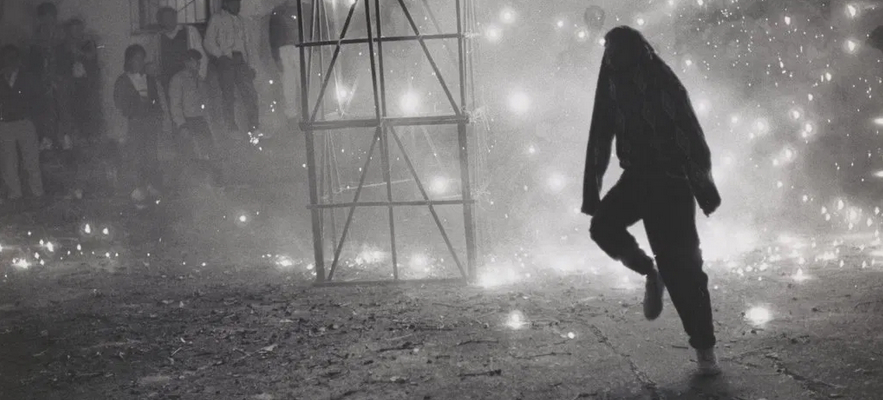
Manuel Alvarez Bravo, 'Fireworks in the Barrio del Niño,' 1990. [o]
JAMES CULLINGHAM As a Mexican journalist investigating the cartels, you had to seek refuge over a decade ago and now living in Canada. Obviously things are in the news. I just want to begin here. With the capture and death of El Mencho (Nemesio Oseguera) on Sunday, the government of Claudia Sheinbaum is going to great lengths to try and state that the crisis has calmed, that the state of violence and reaction in mostly western Mexico and that it has calmed. Is that your impression from your contacts there?
LUIS HORACIO NÁJERA This is the typical political behaviour or criminal behaviour when something like this happens. First of all, the leader is either arrested or killed, so of course there's an immediate retaliation by the criminal group that this person led. This is what happened in Mexico on Sunday and Monday, and eventually it's going to be reducing the intensity of the fighting. That's one thing, but lying to the people by saying that everything is okay, that's a whole different story.
I'm telling you that she's lying because, again, for those of us who follow this kind of incidents, we know that after the initial outburst of violence, violence continues, but instead of being violence against the government, it's now violence within the criminal organization. Why? Because you lost your leader, so there's a bunch of guys looking for the seat at the throne. The dynamics of violence is going to be shifting from burning cars, shootings is going to be different.
Now, it's going to be inside the organization. Now, based on what has been happening over the last 10, 15 years, I think organized crime groups understood that a lot of their differences need to be solved in silence or at least in a very unnoticeable way, which means and takes us to one of the biggest lies in the Sheinbaum administration, actually in the Morena's administration, because both López Obrador and Sheinbaum, which is violence is reducing, yes, but you have a significant increase in disappearances and you have a significant increase in mass graves being found, which means that these people kill each other and then they hide the bodies.
CULLINGHAM As you said, Sheinbaum is the president of Mexico, the representative of Morena party, the party that her mentor — AMLO, Andrés Manuel López Obrador, her mentor — he had a policy that he pronounced as abrazos no balazos — that's to say hugs, not bullets — to try and calm organized crime in Mexico through better social services and less overt conflict with them on the part of the government, the army and the police. Some analysts say that Sheinbaum has parted with her mentor on this approach. Do you see it that way?
On Monday, you have this daily press conference where the head of the army cries in front of the town, on camera. We're humans, yeah, but you are the top of the military . . .
NÁJERA No, she's not separating from him. And I wouldn't say her mentor, I would say her idol, her big Tlatoani, the big god of Morena, because Morena works more as a cult rather than as a political party. And no, what happened is Sheinbaum is right now cornered between the pressure of the Trump administration and the pressure from her Tlatoani, AMLO. Because abrazos no balazos was one of the pillars of AMLO's victory in 2018 that he was insisting on — I'm going to send the army back to the base, I'm going to send the marines back to the ports, etc. — she knows she has to follow.
What happened? Well, nothing of this happened. So now, but that populism, cheap populism worked for AMLO. And so now Sheinbaum is, okay, I can't do that because it will be a betrayal to my god.
But she's also cornered by the Trump administration, who is aggressively pushing Mexico into confrontation, like happening on Sunday. And, she's cornered because she needs money, she needs investment, she needs the grace of the United States to keep getting money from wherever she can get it in order to continue to pay all these so-called “social benefits” that Morena is giving to Mexicans. For what impact?
CULLINGHAM You had to leave Ciudad Juarez because of threats to you, yourself and your family, and you came to Canada, you were covering crime, among other things in Ciudad Juarez. The assaults on journalists since you left have, I don't know the figures for the last six months to year, but before then they were only getting worse. Mexico was one of the most unsafe places on the planet for journalists. How has that fed the power of the cartels in the last decade which bridges the last three presidents?
NÁJERA It’s not fed in a proper way. It’s a consequence of corruption and the willingness of the government to protect — and the willingness of Mexican society — to protect its journalists. Let me tell you a quick anecdote that happened on Sunday to me so you can get a sense of how bad the situation is right now. For over the last two to three years, I've written a column for a regional newspaper called Hora Cero. This newspaper, both digital and physical newspaper, believe it or not, has circulation in Southeast Texas, Tamaulipas and Nuevo Leon — the northeast of Mexico and southeast of Texas.
So I have a column there where I have freedom to write whatever I want. Last Sunday I contacted my editor and asked if he would you like me to write something, an op-ed,, a short article or something to give some context and analysis about the situation with El Mencho. He said, “Hmmm . . .” followed by a long, long pause. Then he said, “You know what, I think we should wait.” That's it. It means they don't feel safe publishing.
CULLINGHAM Are you saying the society and some journalists are engaged in a kind of — tell me if this is too strong a phrase — self-censorship because of the recent events and the general climate?
NÁJERA There's no self-censorship. It's censorship, pure censorship, because it doesn't matter if it's decided by yourself or by the situation. With this newspaper, because of the area where they publish, there is has a significant presence of organized crime. They had past incidents of shootings and threats and everything. So I don't want to put them in that position again. So that gives you an idea of the fear among journalists. Also, on Sunday, there's a video from a content creator reporting in Puerto Vallarta. He is just walking and talking and streaming. Suddenly a car stops next to him and you can hear the voices of people say, “Hey, you have to come with us.” It's not a marked police car or anything. He's grabbed and basically kidnapped. Then the streaming ends when you hear the voice of another guy saying, “Hey, give me your phone, give me your phone!” And boom. So this kind of situation that journalists are facing right now.
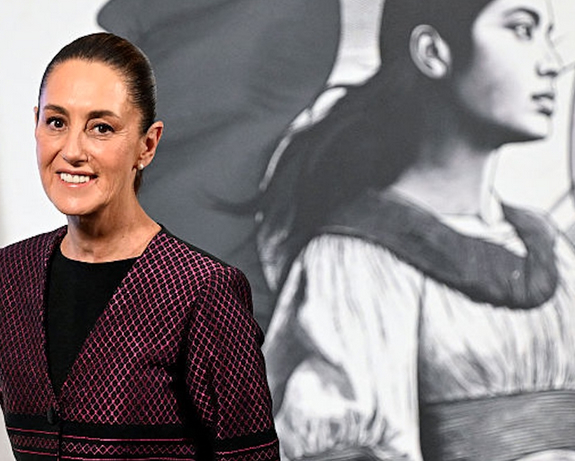
President Sheinbaum . . . negotiating between abrazos no balazos (hugs, not bullets) and domestic fear and pressure from the US.
CULLINGHAM Do we know what happened to this citizen journalist?
NÁJERA He was slapped around and then freed. The idea was not to attack the citizens, but to attack the government. If you check the media you can see that at least during the first day, when El Mencho was killed, most of the reports came from citizens — people recording from their balconies or on the streets.
This is a very interesting issue, which opens a new conversation. If you check media today, especially big media in Mexico, like Televisa, it seems that a lot of these journalists had access to the house where El Mencho was sleeping before he fled and was captured and later died. You don't get access just by walking. You need access from the government. So what I'm seeing now is the government trying to do two things.
One, which it is doing already, is giving access to certain media, to certain places and locations in order to feed the need for information, especially explosive information. Oh, here we are at the house of El Mencho. You can see Hollywood-esque kind of type of information, which the government is controlling.
CULLINGHAM But they also are going to be leaking information through photos, and names. Why?
NÁJERA Because they need to control the narrative of El Mencho becoming a disgraced man and the government was powerful enough to kill him. And this is done consistently. But in this particular situation, it's unique because between Sunday and Monday the federal government mismanaged his position and the information related to his case. First, on Sunday, President Sheinbaum, just used social media to post a very weak press release.
CULLINGHAM As in, "It’s OK, people. The government has got this. Everything is under control!"
NÁJERA Yes. Excuse me, Dear President, you have 20 states in flames, burning, literally. You have the miscommunication between the military and the public safety secretariat because the military sent a press release saying, oh yeah, we have assistance from the United States. Meanwhile, the public safety secretariat says, uh, we're doing this and that, but they never mentioned the US assistance. On Monday, you have this daily press conference where the head of the army cries in front of the town, on camera. We're humans, yeah, but you are the top of the military, that’s not an acceptable reaction in front of the country. It has been very chaotic, everything.
CULLINGHAM You’re speaking to me now from your home in Toronto, but you do on occasion get to Mexico.
NÁJERA Yes.
CULLINGHAM What do you think Mexico is going to experience in the coming weeks and months?
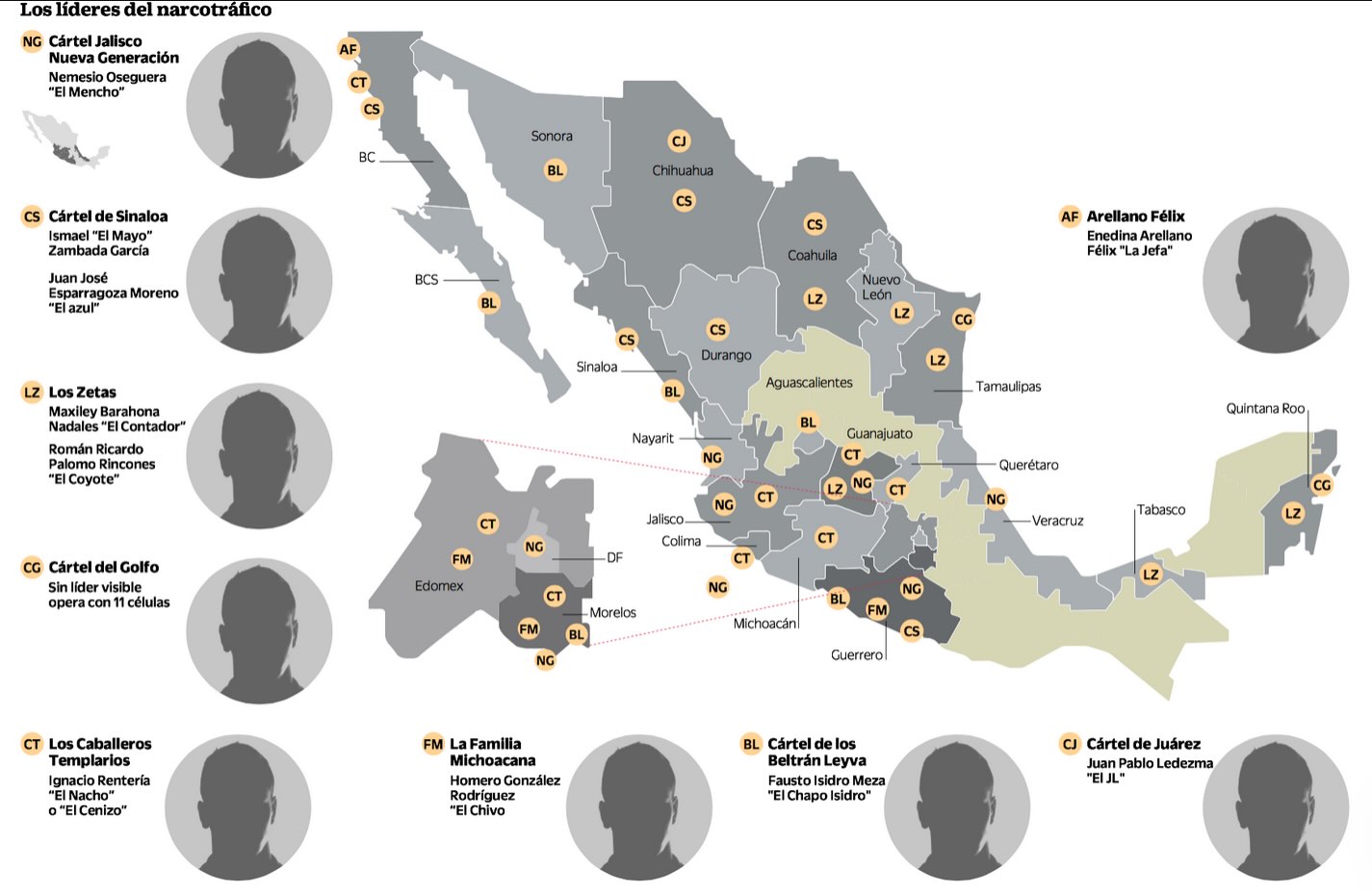
NÁJERA The violence is going to shift from violence against the government into violence within El Mencho’s Jalisco Nueva Generación group. One the things that he did well was he reorganized the structure of the organization in a more horizontal way, having several semi-independent lieutenants in charge of different locations and different activities. So they will solve their differences pretty much by killing each other. That’s what is about to happen.
The other thing is, territorially speaking, this is probably the largest organized crime group in Mexico. If you have violence in 20 states at the same time that tells you something. So because these leaders work semi-independently, the dynamics in each state will be different. The other big thing is that, since a few months ago, Nemesio Oseguera and his Jalisco organization were helping the Chapitos group in their fight against the son of Ismael Zambada, ‘El Mayo’, in the internal fracture within the Sinaloa group. So that is also going to create a new, a new dynamic.
CULLINGHAM Are those fighting with Los Chapitos going to merge and create a new group?
NÁJERA Probably. So this is very important. Yu might think the response from the government is going to be boots on the ground, sending out soldiers. No, the real response from government is — which we just started to see it today — is going to be electoral reform. Morena understands that if they want to retain power, they need to change the law to control the elections. With all these things happening all over Mexico, it's going to be really hard for them to stay in power next year — and there are intermediate elections next year, state government renewals. That’s very important. And, inside Morena, there has been already fractures. That's the key part for Mexico now.
CULLINGHAM What would you like to see the Canadian government do in these circumstances?
NÁJERA The Canadian government should be pressuring Mexico in a very Canadian friendly way to stop destroying institutions. The Canadian government should say to Mexico, hey, this electoral reform that you're, that you're considering to, which basically weakens and, and seize control of the elections is, is, is not okay. If you want to be our friend and partner, you need to do better and return all these institutions you basically destroyed over the AMLO administration and the Sheinbaum administration. Behind closed doors, of course, secret meetings.
From the Canadian society, I think there must be more understanding of the situation. If you have a property in Puerto Vallarta or plan to go there, be careful. But also, show some empathy for the Mexican people. ō
LINKS
'How Mexico Got So Violent', a podcast from the Mexico Political Economist.
Read Luis Horacio Najera's 'Letter from the Borderlands in Exile' in these pages.

JAMES CULLINGHAM is the host and producer of Maintenant sur les ondes (Now on the airwaves) on Trent Radio (92.7Mhz in the south-eastern Ontario area, or at www.trentradio.ca. He is also an author, filmmaker and journalist who teaches Trent University. He lives in Peterborough, Ontario.
LUIS H. NÁJERA is a journalist and the author with Peter Edwards) of “The Wolfpack: The millennial mobsters who brought chaos and the cartels to the Canadian underworld” and Ten10 Most Influential Hispanic-Canadians, 2022. He lives in Toronto.
This interview was broadcast on February 25, 2026 on Maintenant sur les ondes (Now on the Airwaves), Trent Radio.
Add new comment