
Sunscape in Yellow and Green. 2024. Photograph by Whitney Smith.
"My relationship to death is that I was diagnosed with terminal cancer in December of 2022. Now it's September 2025, I just turned 39 and I still have terminal cancer and am still in cancer treatment. Back in 2022 they said two to three years, so I’m still within that window, and this December will be three years. So three years, five, something like that.
WHITNEY SMITH Can you take us back to what your life was like before the diagnosis?
KALEIGH TRACE Long before my diagnosis, I worked for most of my adulthood in the realm of sex education, which is another thing that people shy away from, even though we're inundated with it constantly. I spent a long time swimming in the waters of that, which is a kind of taboo, and I wrote a book about sex in 2013 — Hot, Wet, and Shaking: How I Learned to Talk About Sex — and what it means to be disabled and be a sexual person. I've always been disabled, so that’s not new. From a car accident in the 90s when I was a child — resulting in a spinal cord injury — so I walk with a gait impairment and use a cane.
What people are thinking in a negative way doesn’t usually come out, but it is felt.
SMITH And disability is also somewhat of a taboo, is it not?
TRACE It definitely is. So I have lived a life where I've had to figure out how to talk to people about things they don't want to talk about — disability, illness, sex, the messiness of bodies.
When I received my diagnosis, it made sense to keep writing and talking about death, especially about it as a taboo. For instance, to have a terminal diagnosis is neither my personal failing, nor is it shameful. Yet the way people respond to death often casts it that way. Witnessing this kind of response led me to become much more public about it. It felt strange to suddenly be this thing, or have this thing, that people think is so different when actually it's the thing we're all doing. We're all moving towards the same result.
SMITH Yet in your case it is not sudden or unexpected. You have time to be with it, not for weeks or months but for years.
TRACE True. This is a particular type of dying. Dying over time. You have time to contemplate it with your family and friends and your whole community.
SMITH Can you tell me about what that was like?
TRACE What people are thinking in a negative way — and by this I mean in a terrified and shocked way — doesn’t usually come out, but it is felt. Though it’s rare, some people have actually said to me, “You’re so unlucky.” People have this feeling of like, “Oh, did you hear about Kaleigh?” It's not said meanly or cruelly. Few people are cruel, but many are very uncomfortable. Nothing new. We don’t want to talk about dying.
SMITH Why do you think that is?
TRACE I think it’s because we don't want to consider the truth that we're going to die. And maybe it's different in your age bracket than mine, because your kin and friends are dying more than mine.
WHITNEY They are. My cohort is experiencing it fairly frequently, but also preparing for it all the time. We’re aware that it is not so far away, that we have less runway than others who are younger. The Grim Reaper may step into the shadows at any moment.
TRACE We have this image of a Grim Reaper and we have images of illness, discomfort and pain — and we have ghosts. If we look at our phones now, death is everywhere. Mass death, war, what might come of the climate crisis. A question I have is — Has death become more frightening because it's more visible to us? And though I don't pretend to not be frightened by it, I don’t, to be honest, feel particularly frightened. That said, I don't pretend that what’s coming is easy — the process of death. We prefer pleasure to pain. Death is probably going to be painful.
SMITH In our country, Canada, and some others, there is a tool we can access to address that issue. Here it’s called MAID — medical assistance in dying.
TRACE Since I've been disabled for about 30 years, I’m very aware of the disability justice opposition to MAID, which is based on the idea that the government has deemed it easier to kill disabled people than to fund their lives. In the language of this opposition, people now choose MAID because of the poverty of their disability. I think about this argument a lot, it’s not without merit. But at the same time, I'm incredibly grateful to have access to MAID. I think it's humane and important, and I intend to utilize it. At this time in my life, knowing I am dying, it gives me comfort. To live with an illness is to suffer and live with pain — I am not without pain. To know I can decide when the pain is too much and that I have an avenue for release from this life, that is a good thingt. So, I strongly believe in our right to access MAID and consider it an incredible privilege, while being aware of arguments against it in the context of disability.
Aurora #2. 2023. Photograph by Whitney Smith.
SMITH It seems that having the option of MAID allows us to think more about death than we might if we didn’t have it. In the sense that I don’t have to block out the possibility that I might go through a prolonged death without relief.
TRACE I agree. I just finished watching a TV series, Dying for Sex. It's really beautiful. A true story about a woman my age who gets diagnosed with terminal cancer. In the final episode, you are watching this woman die in a hospice, but she doesn't have access to MAID. And so they described to her the way that she will lose her mind over the next month as she slowly dies. It was so horrendous to me. That I don't have to do that exact thing, that I get to decide for myself. What a right! What a privilege. To decide for myself when to leave this earth.
SMITH Yeah. So other than the departure, the end of a life, which I wanna come back to, the process for you is erased.
TRACE What I can say is, I am enduring. I’m on my third round of chemo, I’ve done radiation and I've had major surgeries. I have a high capacity to endure and I love living. And so I intend to endure a lot, but to know that I have the ability, when the relentlessness of cancer becomes too much, that I get to opt out, yeah.
SMITH What you’re saying seems to be the kind of thing a very brave person says. Would you say you're a courageous person?
TRACE I don't think so, not anymore than other people. Yet, I am a joyful person and that makes it easier. When you love being alive it makes it easier to endure the hardships of life.
SMITH When I first met you I was struck by the joyful, attractive and positive impression you had on me. I know I am not alone in that. Would you agree that you have a positive attitude about pretty well everything?
TRACE I think that that's true. I like being alive and I'm pretty joyful. I grieve and there's a lot of room for grief and sorrow. It would be dishonest to say, oh, my life is all good and I'm happy. I'm often sad. I don't want to die. And I wish that I didn't have this diagnosis. And there was a lot of hardship in it.
SMITH Can you tell me about that hardship?
TRACE I am a single woman in my late thirties. It is hard to do this by myself. Though I’m not alone — I have a lot of friends — I live alone. There are days when I'm tired and I wish somebody else could get the groceries. That can feel really sad, like, oh, there's a lot of responsibility to being an adult in this world. Managing it alone while also managing this illness. It's demanding and it makes me sad. And I am very sad. Of course, I was out last night with friends for dinner. Today I'm going to a book club. My home is beautiful. I love my work. And as a couples therapist, I get to spend days talking to clients about the way they love each other.
SMITH While being truthful to yourself about your sadness, you seem to be availing yourself of what life is offering you.
TRACE Yes. And my life manages to offer both simultaneously. I try to receive both simultaneously.
SMITH We all feel sadness of different kinds and different amounts. And in most cases our sadness comes from the circumstances of our lives, small and large. The little I know of you tells me that you are conscious about a great deal that’s going on your life, and you meet it head on. How do you meet the sadness that comes to you?
TRACE I think it depends on the day. What I would say for myself is that when faced with an intolerable grief, which for me was a terminal cancer diagnosis at a young age, it takes a long time. It takes a long time to learn how to meet the sadness, and how to bear it." I quit my job because I thought I would be dead soon, and I spent a full year doing nothing but cancer treatment, and actively grieving, which meant being sad every single day. I was very much not emotionally well, which is appropriate for the situation, while also being physically unwell. There was a demanding chemotherapy schedule, which was followed by a very invasive surgery. So I was physically quite weak and I was emotionally devastated by it all.
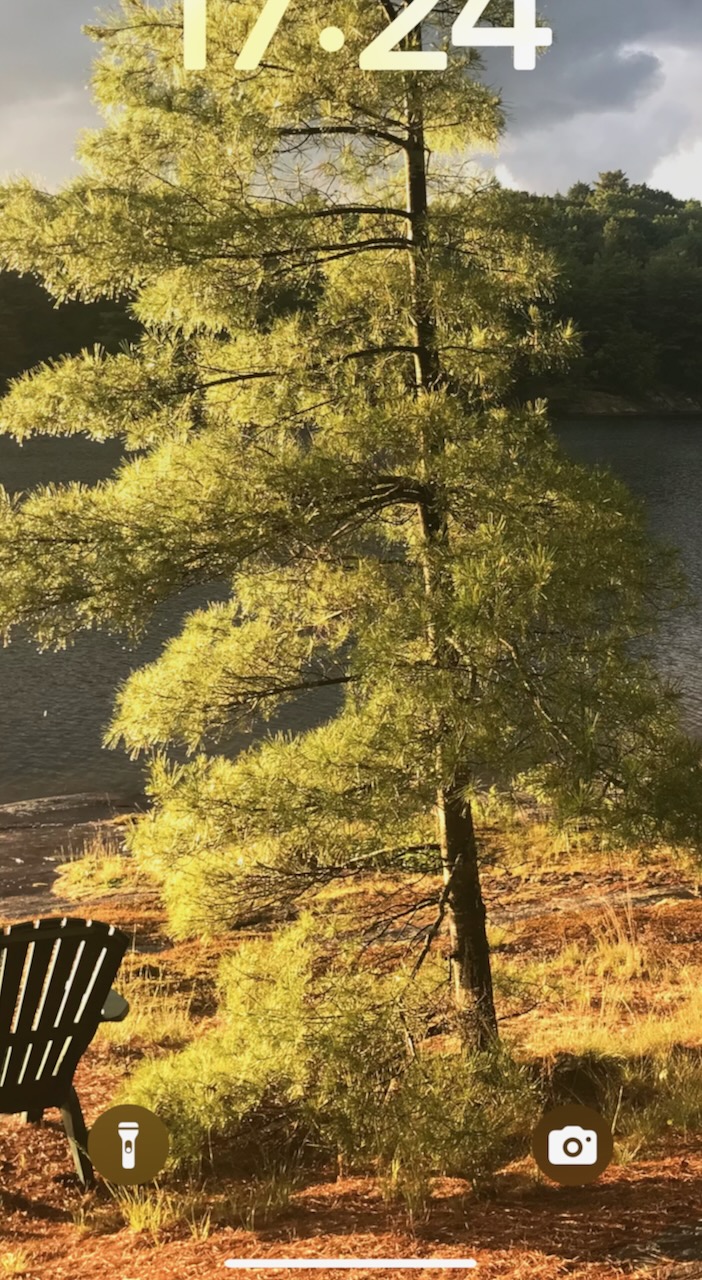
Lake and Chair. 2024. Photograph by Whitney Smith.
SMITH I’m assuming you were depressed, is that right?
TRACE Though I am not a person with major depressive disorder, I was definitely depressed. Not being able to get out of bed, not being able to stop crying, not being able to eat, not being able to see why one would want to live. These are pretty classic symptoms of depression and that's definitely where I spent a chunk of time. As I’ve said, it takes a long time, and luckily, spending time in that state and doing therapy allowed me to move through it. I couldn't force my way out. It was about living in that place. Then slowly, and unexpectedly, life becomes livable again in ways that you can't imagine when you're in that period.
SMITH Would it be accurate to say you recovered from being in that zone or phase of things?
TRACE Yes. For instance, now when I feel sad, as I just did when we were speaking, it doesn't pull me over. I don't have to stop my day. I don't have to cry for hours. I can feel it and be like, oh, yeah, it is sad. And then I think, this cheese tastes really good and I have a nice night ahead of me.
SMITH Martin Heidegger had a notion that as we move through life toward death, we are called to live authentically, and to do so by confronting our finitude. But death isn’t merely an endpoint, a cul de sac, it’s the horizon that gives shape and urgency to our existence. And rather than bemoaning loss or decline, we can embrace what Heidegger referred to as Being-toward-death as a way to fill the remaining time with presence, care, and meaning. The space from here to death is not empty, it’s a volume we can enrich with resolute engagement in the present. Even if my body falters or my mind shifts, I can still live each moment fully, today and tomorrow, if there is one. That is the gift of authenticity: to own our time, not in spite of death, but because of it.
TRACE I like that. What it says to me is, It’s yours. There is a span of time remaining that is yours and only yours to inject with what you will.
SMITH I mentioned Heidigger’s idea because I feel I am talking to someone who is in a deliberate and conscious practice of exactly that, in everything you are doing and thinking about. One by one.
TRACE Yes. As I said, it has taken a long time to make some sense of what is happening to me, and I've learned a lot in that time. Another thing I think about is how much is going on in the world today; how we read about a missile hitting a place in a neighbourhood and from one moment to the next a hundred citizens and families and children are dead. They were here yesterday and now they are gone. All the repercussions of that, all the people who knew them and their families, all that, and we are alive here. We are here living this very privileged life, this life that is uniquely ours.
SMITH You spoke earlier of the TV series that really moved you. Is there anything else that has had a strong effect on you?
TRACE When I got my diagnosis, one of the first books I read about death was Audre Lorde's Cancer Diaries, which are really beautiful. I won't accurately quote her, but she wrote about going home after getting her cancer diagnosis and thinking, My God, I'm going to die. My God, I'm going to die. Then remembering, Oh, yes, I was always going to die. Life, so elusive. To one degree or another, we are always on our way out.
SMITH Leonard Cohen — a person who had a pretty comfortable middle class upbringing — said something I reflect on a lot: “Life doesn't always turn out the way you thought it would.” An interesting statement from someone who had a phenomenally successful and influential career, but useful in terms of unfulfilled or surprising expectations.
TRACE That’s for sure. It didn't turn out the way you thought, but you adjust. Something you learn as you get older, and not so much in your twenties.
That hyper positive rejection of reality, when people come in hot with a kind of performative joy — which is a natural inclination for many of us — they need to be aware of when they're doing that.
SMITH At the age of 63 my father had cancer and was given six-months to live, which turned out to be an accurate estimate. A month or so before he died he asked my mother and I what we thought of reincarnation and afterlife — what might be on the other side. None of us had an answer. Do you have any thoughts?
TRACE I don’t, really. I wasn't raised with any kind of religion. My mother grew up Catholic, then left the church. My dad is an atheist. I was not endowed with any kind of spiritual belief system. I don't think much about the afterlife, and don’t feel particularly concerned with it. Since getting cancer, I am becoming more of a spiritual person to a degree. Not in a religious sense that I want to join a particular belief system, but that life feels more sacred than I ever understood it to be. I really think life is sacred. Being alive is such an incredible gift. Getting to know other people, getting to know each other is amazing. And that there's something in this world that's beyond what I can begin to understand. I have no good words here because I am so not steeped in the world of spirituality and religion. It's so foreign and new to me. I wish it wasn’t.
SMITH Here’s a question that may be hard for you, so feel free not to answer it.
TRACE Okay.
SMITH If you were to meet someone who has received a similar diagnosis to you and who is going through the really difficult early period you described, what would you say to them?
TRACE That is a hard question. I feel grief even thinking about it because I'm remembering how awful that year was. But I can answer it. I don't think anyone could have said anything that could have made it better. There are things that my friends did that made it better: they didn't leave me. Even when I was pretty emotionally unreachable and just a husk of a person on the couch, puking and sleeping, because I was sick from chemo, they came over all the time and waited until I could be me again. That was incredibly crucial to my well-being. So one thing I could say is: wait with people while they suffer. Hopefully this person’s family and friends would do that.
If I could go back and talk to myself at the beginning of 2023, I’d say to myself, like, I promise you, it won't always feel this bad. No one said that to me, but if they had I would have said, “Fuck you. You have no idea how bad this is! It will always be bad.” I don't think you can really say that to somebody. If I could visit myself right now, I would say, I promise you, it won't always be like this.
SMITH Here's another question along similar lines. This same person who has received the diagnosis is my friend and I'm at a loss about what to do and what to say — afraid I'll say or do the wrong thing. What would you advise?
TRACE Everybody’s different, but I’d recommend caution rather than invasion. My friends really invaded me. I was avoidant and I didn't want to talk, but they called every day. Sometimes I didn’t answer the phone, but they would keep calling or dropping by with food or find a reason to pull me out of the hole I was in. “OK, we’re going to see a movie. We’re going to do this then that.” That really worked for me.
Once, in those early months of my diagnosis, a friend came over and she was so sad. When I asked what was wrong she said, “You're my best friend and if you die it's the worst thing that could happen to me.” It was such a gift to know that I wasn’t the only person who felt it was the worst thing that's ever happened, that I wasn't suffering alone.
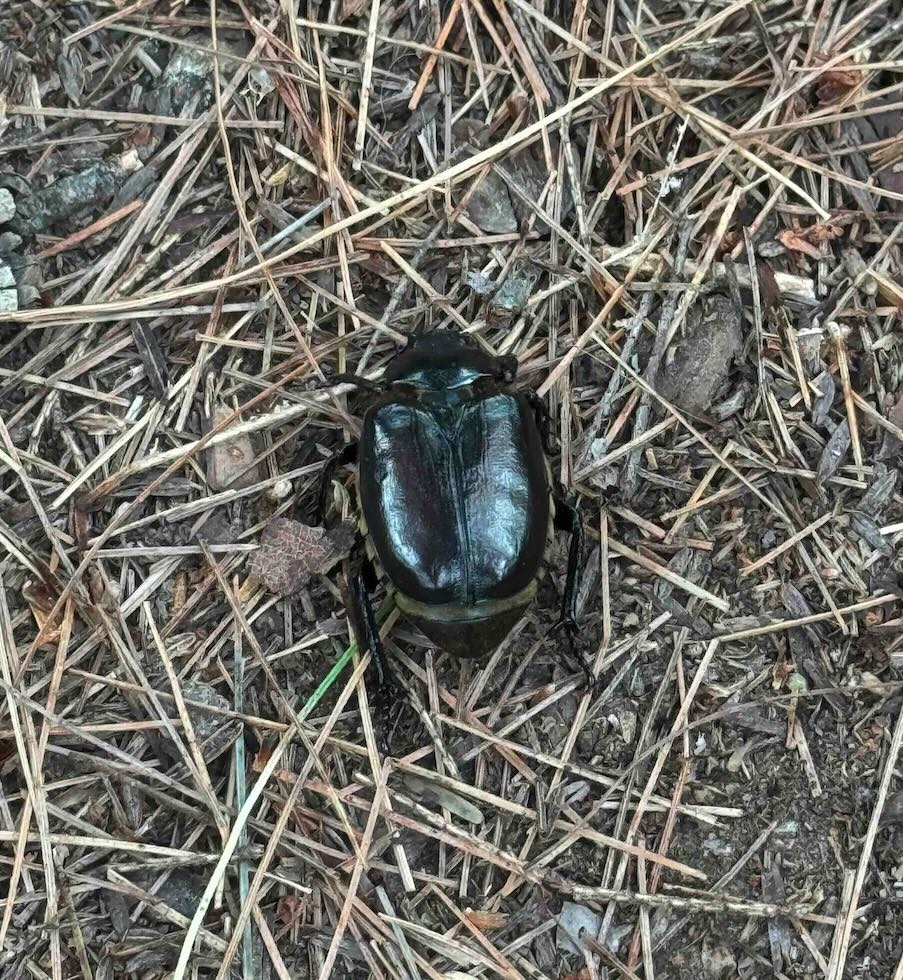
Beetle in the Forest. 2025. Photograph by Whitney Smith.
SMITH And you didn’t think to yourself, which some people might, this has happened to me and she’s just talking about herself?
TRACE No, it felt very generous, which was a surprise to me. When we’re afraid and feel really sad, we don't really want company. Suddenly I saw that what was happening to me was happening to her. It was a real relief to me.
SMITH And you don't want to be cheered up.
TRACE We want to be with ourselves.
SMITH You were also saying that your friend was on the side of invasion, but that this was what you needed on that day.
TRACE Yes. Though I suggested caution versus invasion, it worked for me. Again, everybody is different.
SMITH So, while you’re suggesting letting someone in your situation have their space, not pushing in too much, are you also saying do what you feel deeply that you need to do. I sense that your friend needed to be in your presence to share what she felt.
TRACE Yes. And I was glad she did. And part of it was that it was a gift to feel: My life will end and yours will continue. But a part of your life will end with me. That said, it’s a bit hard if everybody comes over and says, “Hey, it's a great day. I'm biking around and having a great time.” But if people are able to call or come over and call and say, oh, I feel so sad about this today.
SMITH I want to understand more about that, in terms of being helpful to my very ill friend. We haven't been schooled in this. I sure haven’t.
TRACE Well, have you asked her about her own sadness? What does she tell you? What does she tell you she wants? Does she want company? Maybe. Or she tells you she doesn't want to die.
SMITH And I want to hear what she has to say about that.
TRACE [Yes. You definitely want to be listening, being attentive.] There are a few things that aren’t helpful — bearing in mind that everyone is different and one person’s wish may be the opposite of another person’s wish or style. Again, I do not think it's helpful to tell people it will all be okay. To show up and do a song and dance, “Oh, it's a beautiful day. Let's get some sunlight in your room.” That hyper positive rejection of reality, when people come in hot with a kind of performative joy — which is a natural inclination for many of us — they need to be aware of when they're doing that. It's very jarring when a person is basically saying, “Oh, let's not live in reality.”
SMITH What you've just said underlines the enormous learning opportunity available to all of us as we encounter mortality up close. To learn how to be in this place you speak of where we become more intimate with what's really going on, as if we’re inches from the full face of reality.
TRACE I had a situation where I learned something very important. When I was younger, before I got my diagnosis, a member of my community died suddenly. I remember feeling afraid to talk to all the people who were grieving, afraid I would get it wrong. I avoided discussing this big loss, which I think is what people do. Though I forgive myself for that now for it, if I could go back I wish I would have been brave enough to just say, "Oh, I am so sad with you."
SMITH Sad with you. An important difference. It goes back to what you’ve saying: Being where the other person is.
TRACE Yes, being in the reality of the place she’s in. Where she is frightened. Where she’s afraid to die. Maybe her friend or family member is afraid, too, afraid not to feel connected to her as she's dying. So in this way, you're actually in the same spot. You’re in it together. Being with her in the place that she's in.
SMITH And follow the conversation that comes in that place?
TRACE Yes. Let her lead the conversation. And give her the time with you. ō

KALEIGH TRACE is a registered psychotherapist who works with couples, families and individuals as their relationships transform. Her 2014 memoir Hot, Wet, and Shaking: How I Learned to Talk About Sex, which chronicles her experiences as a disabled, queer, feminist sex educator, won the 2015 Evelyn Richardson Memorial Non-Fiction Award at the Atlantic Book Awards. She lives in Toronto.
WHITNEY SMITH is the Publisher/Editor of the Journal of Wild Culture.
Comments
An authentic, moving…
An authentic, moving conversation. There is a lot to be learned here about how to speak to and listen to those who are dying..
I just want to let you know…
I just want to let you know how much I enjoyed (if that is the right word to use for such a serious subject) this article! Thank you, Whitney, for the interview, and thank you, Kayleigh Trace, for your insightful honesty.
— Susanne Severeid
Add new comment